Visual artist and composer Tristan Perich has combined two separate musical concepts: the original performance, and the physical recording. When one purchases a CD (remember those?), it's a copy of a performance recorded weeks, months, often years before.
Not so with Perich's latest release. His 1-Bit Symphony comes in a standard CD case. But inside are some very simple electronics that perform the composition when activated. So every time you listen to the work, you're hearing -- not a recording -- but a live performance.
The symphony gets its name from the electronically generated square waveform. Its such a simple waveform that it can be represented by a single bit of digital information (and remember: a bit is a bit of a byte). Yet Perich does quite a lot with this primal audio building block, creating complex sound structures that are indeed symphonic.
The following video gives you a brief overview of the work, as the presenter hits the fast-forward button to skip through the various movements. When you hear the work as intended, though, you'll hear the themes slowly develop as they would in a Philip Glass or Steve Reich composition.
Will 1-bit music become its own school of composition? Perhaps not.
But Perich has created a valid form of musical expression that's uniquely his own. And that's a remarkable feat, indeed.
Thursday, October 20, 2011

Wednesday, October 12, 2011
Original and rare recordings of Kurt Weill, 1928-1944

 Kurt Weill
Die Dreigroschenoper
Historic Original Recordings 1928-1944
Capriccio
The first disc of this 2-CD collection is mostly music from the Threepenny Opera, including the original cast (1928-31) and select foreign song recordings from 1930-31. While this music by Kurt Weill and Berthold Brecht has received many performances, there has been a subtle shift in interpretation over time.
These recordings document how these songs were first performed, with the brashness and exuberance of early jazz. Listening to the original cast of Die Dreigoschenoper (Harald Paulsen, Carola, Neher, Kurt Garron, and Lotte Lenya) is a revelation. There’s a subversive undercurrent in these singers’ delivery that’s missing in modern performances.
The collection includes not only the original cast, but also the first Dutch recordings of Weill’s music, along with some dance band covers of the day. Also included are 1929 recordings by the Berlin State Opera Orchestra with Otto Klemperer of the Threepenny Opera concert suite.
Disc 2 features a variety of historic and exceedingly rare recordings from 1928-1944. It includes music from Happy End, a unsuccessful comedy. The songs by Brecht and Weill from that ill-fated production were recorded in 1929, but seldom heard since.
“Six Songs” is a transcription of a box set released in 1943. These American releases feature Lotte Lenya (her voice already starting to darken) with Weill’s piano arrangements made specifically for the recordings. The collection ends with two anti-Nazi political songs Kurt Weill and Bertolt Brecht wrote for the Office of War during the Second World War. These were broadcast into Germany via shortwave in 1942 and 1944 sung (of course) by Lotte Lenya.
For the most part, the transfers are very good. Surface noise is minimal, and the sound isn’t over-processed. These are mono recordings, and there’s some compression, but not more than what one would expect from shellac discs almost a century old. I found this a fascinating collection of music, and one that provides historical context to Kurt Weill’s compositions.
Wednesday, October 5, 2011
Schnittke String Quartets: Modern Classics
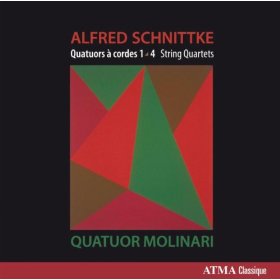
String Quartets 104
Quatuor Molinari
Atma Classics
This two-CD set presents all four of Alferd Schnittke’s string quartets. The first was composed in 1966, and the remaining three over a relatively brief span in the 1980’s.
The first quartet is very tonal and contrapuntal. There’s a lyricism I find very appealing in the music, perhaps even a neo-romantic undercurrent.
It would be fourteen years later that Schnittke would return to the genre, and the second quartet attests to the changes in the composer’s style. This is a more aggressively modernist work, and I heard traces of minimalist drive coupled with the angularity of Stravinsky mixed together in an exciting fashion. (Speaking of which, also included the Canon in Memoriam Igor Stranvinsky, a short work that shows Schnittke’s deep respect and understanding of Stravinsky’s music.)
The third quartet, written just three years after the second, sounds radically different. It opens with lush modal harmonies that set the stage. As the work develops, it becomes increasingly dissonant, but never very much so. Of the four quartets, this is Schnittke’s most neo-classical work, which makes it the most accessible as well. No wonder the Quartuor Molinari chose to start the program with it!
By contrast, Schnittke’s final quartet is a much sparser work. It seems very pointilistic – often only one instrument is playing at a time. This elegiac quartet gradually building in intensity, leading to a powerful finish that seems sum up not just the composition itself, but Schnittke’s thoughts on the genre as a whole.
The Quator Molinari specializes in contemporary repertoire, and is perfectly at home with these works. As with all good chamber music, there are conversations going on between the instruments that help bring cohesion to Schnittke’s music. These were recordings I found myself returning to several times. Highly recommended.
Subscribe to:
Posts (Atom)