Showing posts with label contemporary music. Show all posts

Monday, September 22, 2014

George Crumb, Vol. 16 - Spanish and American Songbooks

George Crumb Edition, Vol. 16
Voices from the Heartland; Sun and Shadow
Ann Crumb, soprano; Marcantonio Barone, piano; Patrick Mason, baritone; Orchestra 2001; James Freeman, conductor
Bridge Records


Bridge Records' sixteenth(!) installment of George Crumb's compositions feature two works that are both similar and different. Sun and Shadow is another collection of songs based on the poetry of Federico García Lorca. Lorca's work has inspired several Crumb compositions, including the Ancient Voices of Children. This set, subtitled Spanish Songbook II is classic Crumb. In this case, he uses just an amplified piano to create his unique soundscapes, making this a somewhat intimate composition

Voices from the Heartland (American Songbook VII), presents Crumb's arrangements of some traditional American songs. Baritone Patrick Mason and soprano Ann Crumb perform, along with the James Freeman and the Orchestra 2001. Actually, these songs are more re-imaginings than arrangements.

While the melodies of such tunes as "Softly and Tenderly (Jesus is coming)" and "On Top of Old Smokey" are easy to pick out, they've been transformed by Crumb's imagination. Triadic harmonies are replaced with clouds of sound; phrases are broken up and folded back upon themselves; melody and accompaniment veer off in different directions. And yet, rather than obscuring these simple songs, Crumb brings out the deeper emotional themes that, in retrospect, were there all along.

Ann Crumb has extensive experience singing in Broadway shows. While she sings Sun and Shadow in a clear, classical tone, she lets her musical theater roots show in the American Songbook. Which somehow makes these transformed American folk songs sound even more authentic.

Wednesday, September 17, 2014

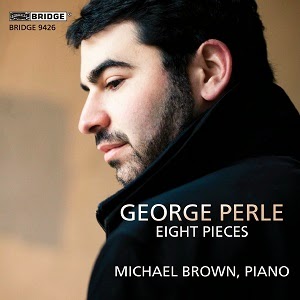
George Perle Portrait in Eight Pieces

George Perle: Eight Pieces 1938-1997)
Michael Brown, piano
Bridge Records


Every composer should have a champion. For George Perle, that champion is pianist Michael Brown. As a teenaged virtuoso, Brown fell in love with Perle's music and had an opportunity to meet the composer. That developed into a close personal and professional relationship over the years, culminating in this release.

Brown collects not only Perle's published works for solo piano, but some earlier works still unperformed at the time of Perle's death. Brown has a deep understanding of Perle's music, and that makes this collection so exciting to listen to. The eight works span Perle's creative output. The earliest work, the 1938 "Classical Suite" receives it's world premier recording here.

In many ways, it's similar to Prokofiev's "Classical Symphony." While using traditional forms and mostly tonal harmonies, Perle continually plays against expectations as his melodies veer off into unexpected directions.

The "Six Celebratory Inventions" (1989-1997) is the collection that Brown played for Perle as a teenager. Each invention honors a different composer by imitating his style. And while one can hear the dedicatee in each movement -- Leonard Bernstein, Gunther Schuller, Ernst Krenek, et al -- it's all filtered through Perle's inventive imagination, giving this set an overarching sense of cohesion.

Michael Brown has lived with some of these works for a while, and he plays with authority and sensitivity. Perle isn't primarily known for his keyboard compositions. Brown's performances suggest they should be reassessed.

Monday, September 15, 2014

Poul Ruders, Vol. 9 - Amiable Chamber Music

Poul Ruders, Vol. 9
David Starobin, guitar; Daniel Druckman, percussion; David Holzman, piano; Amalia Hall, violin; Hsin-Yun Huang, viola, Sara Rothenberg, piano
Bridge Recrods

The two words that sprang to mind as I listened to this collection of Poul Ruder's chamber music was "amiable atonality." These chambers works move well beyond tonality, without a hint of academic dryness. Every work had real personality, often full of warmth and gentle humor.

Guitarist David Starobin and Poul Ruders have enjoyed a long and fruitful collaborative relationship, and Starobin brings his deep understanding of Ruders' music to two works. The "New Rochelle Suite" for guitar and percussion is a witty composition, and Starobin and percussionist Daniel Druckman perform it with a sometimes wink at the audience. Ruders scores imaginatively for percussion, making non-tonal instruments such as the castanets and tom-toms (among many other) add nuanced shading to the guitar's wide-ranging melodies.

"Schrödinger's Cat" is a set of 12 canons for violin and guitar that reflect the ambivalence of the title. In quantum mechanics, Schrödinger's cat is a thought experiment illustrating the paradoxical concept that particles can be in two states simultaneously until observed. So, too, these canons seem to shift back and forth until they suddenly collapse into a final cadence. Starobin and Amalia Hall perform these canons in an unadorned fashion, just presenting the facts -- which seem to change before our ears.

"Romances for viola and piano" is romantic in nature, but the expressive yearnings of the melody get their poignancy from decidedly post-tonal chromatic inflections. Violist Hsin-Yun Huang and pianist Sarah Rothenberg make a great team, though, bring out the emotion in the music without being too emotive.

David Holzman performs "Twinkle Bells - Piano Etude No. 2" with a light, deft touch. He makes the cascading thirds that make up the bulk of the etude shimmer and tinkle like tiny bells. He also brings the album to a close with Ruders' "13 Postludes." These are wonderfully-crafted short little works that evoke the spirit of Chopin -- in an amiably atonal way.

Wednesday, September 10, 2014

Lior Ronser: Awake and Dream

Awake and Dream
Works by Lior Rosner
Janai Brugger; soprano
Katia Popov, violin
The Hollywood Studio Symphony
Steven Vanhauwaert, piano
Lior Rosner, conductor, piano


Lior Rosner is best known for his film and TV scores, which show the wide range of styles he's mastered. This collection of his classical works betrays some of that background -- the music is mostly tonal, and is more about conveying atmosphere and emotion than being concerned about formal structure. And yet these works aren't just fleshed-out film cues. Rather, they're compositions of real substance -- post neo-romantic, if you will.

Rosner's featured soloists are real standouts. Katia Popov performs with a clean, slightly steely tone that's well-suited to these modernist works. Awake and Dream is an impressionistic work that seems to float between dream and reality. Popov spins forth the long, flowing melodies effortlessly, moving from motive to motive seamlessly. The solo violin work "G-Pull" lets Popov display some of her technical skills, but it's her shaping of phrases and subtle articulation that holds the piece together.

Soprano Janai Bugger has a rich, warm voice, with an upper register that sounds well-rounded and clear. She beautifully performs "In time of Silver Rain," a song cycle based on Langston Hughes' poetry. Rosner's settings sound more like Copland and Barber than Duke Ellington, giving these poems a universally American character, rather than African-American. Bugger performs them in a simple, straight-forward fashion, letting the words themselves deliver the emotional impact. By contrast, Bugger provides the emotion for "Three Poems by Sappho." Her singing communicates the full range of emotions this cycle expresses, from ecstatic love to deep mourning.

While the soloists shine, the ensemble could use some polishing. The Hollywood Studio Symphony is a pick-up ensemble, made up of session musicians contracted for the project. There's nothing wrong with that -- but sometimes the ensemble doesn't quite jell. Attacks are a little imprecise and some entrances seem a little tentative. It's not a horrible sound, just a little rough around the edges. I'd be interested in hearing these works performed by an orchestra that has lived together for a while. I expect it would really make the music come alive.

Monday, September 1, 2014

Isserlis Energizes Martinu Cello Sonatas

Martinu: Cello Sonatas 1-3
Works by Sibelius and Mustonen
Steven Isserlis, cello
Olli Mostonen, piano
BIS SACD

Steven Isserlis turns in an attractive program of cello music with this new SACD. Bohuslav Martinu wrote in a very distinctive style; one that was remarkably consistent throughout his long and prolific career. Martinu wrote tonal works, but they were his own version of tonality. Dancing syncopations and shimmering chords are Martinu trademarks, and they're here in abundance.

Playing two or more of Martinu compositions back-to-back -- especially ones using the same forces -- can have the effect of blurring them together. Isserlis avoids this by interspersing works by two composers whose styles complement Martinu's, simultaneously providing contrast and creating a coherent program.

Jean Sibelius' Malinconia, Op. 20 is a dark work, written after the death of the composer's infant daughter. Isserlis convincingly brings out the pathos of the work, while at the same time savoring the beauty of Sibelius' extended melodic lines.

Pianinst Olli Mustonen not only partners with Isserlis in these performances; he also provides a sonata as well. Mustonen's post-romantic composition fits in nicely with the Martinu and Sibelius works, with plenty of rich sonorities and juicy melodic tidbits.

Isserlis doesn't hold back in these performances. Martinu's music has a certain lightness to it, but Isserlis makes it more compelling by really digging into the notes. The urgent character his technique brings to these works makes them, in my opinion, some of the best recorded versions of Martinu's cello sonatas to date. And if you have an opportunity, listen to this release through an SACD player. The intimate nature of this chamber music becomes all the more vivid with the additional sonic details the format provides.

Tuesday, July 15, 2014

Violist Antoine Tamestit Performs Hindemith

Hindemith
Antoine Tamestit, viola
Markus Hadulla, piano
Frankfurt Radio Symphony Orchestra
Paavo Jarvi, conductor
Naive


This release spans the breadth of Paul Hindemith's writings for the viola, from solo sonata  through music for viola and orchestra. Hindemith was a violist himself, and his compositions fully realize the instrument's potential. Violist Antoine Tamestit fully understands these works and their creator, as his interview printed in the booklet shows -- as do his performances.

Tamestit notes that there is a lot of humor in Hindemith's music, and he brings it out in all of these works. Still, I'd have to characterize the orchestral works here as ones of mournful beauty. "Der Schwanendreher" is a reworking of folk songs relating to isolation and loss, composed when Hindemith was being force out of musical life by the Nazis. Tamestit subtly brings out those emotions, making the music sound wistful rather than maudlin.

"Trauermusik" explores similar themes. Hindemith's thickly-textured harmonies provide a melancholy accompaniment to the yearning melody of the viola. Paavo Jarvi and the Frankfurt Radio Symphony Orchestra perform with a warm, blended sound that's ideally suited to these works.

Tamestit's performance of the solo sonata Op. 25, No. 1 is a wonderful balance of emotional expression and tasteful restraint. The structural elements are all clearly delineated, and the motives are carefully phrased to help the listener connect them as the work goes along. And yet there's a fiery passion continually roiling under the music, straining to break free.

Hindemith's sonata for viola and piano, Op. 11, No. 4 is a beautiful collaboration between Tamestit and pianist Markus Hadulla. At times the music seems to have a sweetness to it that's quite charming. As with the best chamber music performances, one has a sense of eavesdropping on a conversation. In this case, one between two good friends.

Monday, July 14, 2014

Susan Rotholz's Tapestry of American Flute Duos

American Tapestry
Duos for Flute and Piano
Susan Rotholz, flute; 

Margaret Kampmeier, piano
Bridge Records


The album is titled "American Tapestry," but it's no crazy quilt. The four duos for flute and piano Susan Rotholz and Margaret Kampmeier perform fit nicely together. All are tonal after a fashion, giving the program coherence; and yet each differ in character to give the listener real variety.

Robert Beaser takes a simple theme and lets it logically unfold with his "Variations for flute and Piano." Some of the harmonies have an open quality to them, which makes the Variations a nice lead-in to Aaron Copland's "Duo for Flute and Piano." This 1971 work has the wide open sound of Copland's Americana works.

Robert Muczynski's "Sonata for Flute and Piano" also fits well. to my ears, the work has a Ravel/Debussy quality to it, with a hint of Samuel Barber. That's not a bad combination, and one that makes for an attractive and enjoyable work. The album concludes with Lowell Liebermann's "Sonata for Flute and Piano," and almost seems like a further development of Muczynski's work. Liebermann's work is just as artfully constructed, with melodies that can only be described as beautiful.

Rotholz plays with a clear tone that's never out of control. Even when the music takes the flute into the extreme upper register, the sound gets brighter but never shrill. The recording is also well-balanced. Both flute and piano are on par with each other and sitting comfortably in the soundfield; close enough to hear all the detail, without capturing any harshness.

Monday, July 7, 2014

Nadjia Salerno-Sonnenberg's Fresh Batch of Concertos

From A to Z
21st Century Concertos
New Century Chamber Orchestra
Nadja Salerno-Sonnenberg

This new release presents four violin concertos written in the 21st Century from Clarice Assad, William Bolcom, Michale Daugherty, and Ellen Taaffe Zwlich. Two of them -- the Bolcom and Dougherty -- were commissioned by the ensemble. All benefit from the outstanding musicianship of the group and their talented music director, Nadja Salerno-Sonnenberg.

Clarice Assad's "Dreamscapes" is meant to evoke the ethereal half-conscious world of dreams, and does so effectively. This isn't a violin showcase type of concerto. Rather, the solo instrument seems to travel through soundscapes conjured up by the ensemble."Romanza," by William Bolcom is more straight-forward work. Bolcom's fascination with American musical forms manafests itself in the finale's cakewalk. "Romanza's" post-romantic construction allows for plenty of expression, and Salerno-Sonneberg rises to the occasion. Her violin practically sings, wresting every bit of emotion out of Bolcom's music.

Michael Daugherty treats the ensemble as a large string quartet in "Fallingwater." The work divides the ensemble into four parts, similar in structure to a string quartet. Daugherty's music often has pop inflections, and "Fallingwater" is no exeption. But those influences are understated, providing a freshness and energy to the score without being obvious.

The final work on the album, "Commedia dell"Arte" by Ellen Taaffe Zwilich is in many ways the most traditional (if one can use that term for 21st Century music). As the title suggests, Zwilich uses the characters of commedia dell'arte as her point of inspiration. Each movement presents a musical portrait of one of the stock characters. There's an Italinate light-heartedness about this score, and Salerno-Sonnenberg's bow fairly dances across the strings.

These concertos aren't necessarily about virtuosity; but they are about musicianship. Each one is a partnership between the soloist and the ensemble. Both halves need to be fully committed to deliver successful performances of these works; and there's no question that Nadja Salerno-Sonneberg and the New Century Chamber Orchestra delivers.

Monday, June 9, 2014

Julia Wolfe: Steel Hammer - John Henry Redux

Julia Wolfe
Steel Hammer
Bang on a Can All-Stars

Trio Mediaeval
Cantaloupe Music

The legend of John Henry has grown and changed over the years. Was John Henry real or fictional, black or white, short or tall? Virtually every detail of the story has multiple answers -- and that's the point of Julia Wolfe's work, "Steel Hammer." Wolfe ingeniously presents the multiplicity of the story with layers of sound that simultaneously obscure the text and make transparent its interpretations.

This is high-energy, complex material, and as with many of Wolfe's compositions, the music demands your attention in an insistent and aggressive manner. But it's only when you give "Steel Hammer" your full attention that the music can convey its meaning.

Trio Mediaeval sing with pure, unwavering tones, providing an unemotional narrative to the work. Wolfe incorporates a number of folk instruments and sounds into her ensemble to provide color and context. Hearing the banjo, dulcimer, or the sound of clogging deep in the mix give the listener a hint of Appalachia without being overtly folk-like.

As always, the Bang on a Can All-Stars hold nothing back in their performances. This is difficult, demanding music, but these musicians don't just play the material -- they own it.

Wednesday, June 4, 2014

"O Fortuna" Mondegreens -- Animated!

A mondegreen is a misinterpretation of a phrase with a near-homophony of the original. Usually this results in a new (and often humorous) meaning. In the case of Carl Orff's "O Fortuna," it can also provide some welcome relief to this over-used and often over-blown work.

Monday, June 2, 2014

Lowenthal Delivers a Potent Post-Modern Program

Jerome Lowenthal: Rochberg, Chihara & Rorem
Jereome Lowenthal, piano
Bridge Records


Pianist Jerome Lowenthal presents an attractive program of works that he has some kind of direct connection to. And that connection makes these not just informed, but exciting and insightful performances.

George Rochberg's compositions make up the bulk of the release, with three works that are similar in construction, yet yield different results. "Carnival Music" (composed for Lowenthal) is a wild mix of academic atonality and commonplace blues, tangos, and marches -- filtered through a fun-house mirror. "Nach Bach" a work Lowenthal champions, is more aggressively atonal, with snatches of Bach interspersed, like sunshine glimpsed through roiling clouds.

"The Partita Variations" features a number of pastiches (again, mixed with atonal elements) that culminate in a decidedly tonal three-part fugue.

Lowenthal easily sails through the sudden shifts in style -- one moment playing heart-on-your-sleeve Tchaikovsky, the next icily stabbing disjunct notes across the keyboard.

Paul Chihara's work, "Twice Seven Haiku for Piano," is the result of a suggestion made by Lowenthal to the composer. It's a set of quite short characteristic pieces that cover a wide range of styles and genres. These are fun little musical vignettes that Lowenthal plays with relish. The album concludes with Ned Rorem's "75 Notes for Jerry," written for Lowenthal's 75th birthday. Lowenthal's tender performance makes the work sound very close to Debussy, a fitting end to this post-modern program.

Monday, May 26, 2014

John Cage: Works for Two Keyboards 2 - A Mixed Bag

John Cage
Works for Two Keyboards 2
Pestova/Meyer Piano Duo
Naxos


John Cage's music can be difficult to listen to. And many times, that's the point. Cage wanted audiences to be aware of the unspoken assumptions about what music was and how it should be listened to -- or viewed. There's often a strong visual element in his work. Which, I think, is the problem I had with "Music for Two."

It's part of his "Music for ___" series. Cage wrote a part for every instrument, and the composition/performance becomes whatever the combination of instruments are at the time. In this case, it's two prepared pianos. The problem for me is that there's just not a lot going on aurally. I suspect seeing the performances interact and the visual cues provided by them moving from one part of the piano to the other would give me a much richer experience. Musically, it sounds like about five minutes of material spread over a 29-minute track.

By contrast, "Three Dances" more than justified the price of admission. This is Cage at his finest. The prepared pianos sound like sophisticated electronics or exotic percussion instruments, which make these 1945 works seem as if they could have been written yesterday. And Cage's complex rhythmic patterns keep things hopping. This isn't the metronomic regularity of minimalism. Rather, these dances crackle and explode unpredictably, yet all the while simmering with energy that can only sometimes be contained.

Xenia Pestova and Pascal Meyer perform these works with amazing precision and obvious relish, even if they couldn't quite sell me on the "Music for Two." That track, I'd recommend only to Cage completists. "Three Dances," though, are for everyone. Those pieces (and the Pestova/Meyer Piano Duo's performance) rock.

Monday, May 19, 2014

Mary Kathleen Ernst: Keeping Time

Mary Kathleen Ernst
Keeping Time
Fung, Higdon, Hoover, Shatin, de Kenessey, Deussen
Innova

Pianist Mary Kathleen Ernst turns in a strong program of solo piano works with equally strong performances. Yes, all the works were written by women, but that's about the only thing they have in common.

Vivan Fung's "Keeping Time" uses the piano as a percussion instrument. This work is all about rhythm, and Ernst delivers an energetic and (in my opinion) very cool performance.

By contrast, Jennifer Higdon's "Secret And Glass Gardens" sounds shimmering and ethereal, almost suspended in time and space. It's almost a companion piece to Debussy's "La cathédrale engloutie"

The "Dream Dances" of Katherine Hoover is a somewhat mysterious-sounding work, with slow-moving passages suddenly bursting forth with up-tempo angular melodies.

Judith Shatin used the I Ching to guide her compositional process, and the resulting music is fasciniating. This 26-minute work is comprised of very short sections, sounding almost like aphorisims. Shatin sometimes has the piano sound very mechanistic, almost like an electronic instrument.

I somethimes think Stefania de Kenessey writes the music others wish they had the courage to. "Spontaneous D-Combustion" has catchy, tonal melodies, supported by full, rich chords and a rhythmic pulse that has more than hint of pop sensibilities.

Nancy Bloomer Deussen's "A Recollection" is a wistful and quiet little work that calms down the listener and makes a peaceful close to the program.

Monday, May 12, 2014

Judith Shatin: Time to Burn

Judith Shatin: Time to Burn
James Dunham, viola
The Cassatt String Quartet

Margaret Kampmeier, piano
Arron Hill, oboe
I-Jen Fang, Mike Shutz, percussion
F. Gerard Errent, D. Gause, clarinet
Innova Records


"Time to Burn" provides an extensive overview of this innovative composer's output. Head collectively, the works brings to light several themes which Shatin revisits and reinterprets in differing ways; her Judaic heritage; using sound (not just musical notes) to create art; and the interface between technology and humanity.

One of the highlights is "Glyph," for viola, string quartet and piano. The music has a very open sound, giving the solo viola plenty of room to maneuver in. The work's elegiac opening gives way to more animated and thickly textured movements. The solo viola remains always at the forefront, sometimes interacting with the ensemble, other times floating serenely above the busyness, and occasionally commenting on the action.

The title track "Time to Burn" is an engaging work for oboe and two percussionists. Extended techniques make the oboe sound almost like an electronic instrument in places. The interplay between the three instruments, and the imaginative way in which they're used gives the music a sense of energy and even urgency.

To me, "Sic Transit" was the least successful work on the album. The piece is for percussionist and computer-assisted drum machine, which the soloist interacts with. I suspect "Sic Transit" works well as a theater piece, where the audience can see the performer react to the drum machine. Without visual cues, I found the music somewhat aimless.

"Elijah's Chariot" was commissioned by the Kronos Quartet, and was written for string quartet and electronics from processed shofar sounds. The shofar is a traditional Jewish instrument made from a horn and used in religious services. Shatin uses the shofar to represent the heavenly chariot that comes for Elijah. The composition is a heady blend of acoustic and electronic, spiritual and secular, emotional and intellectual.

Friday, May 2, 2014

Glenn Kotche: Adventureland

Glenn Kotche
Adventureland
Cantaloupe Music


Glenn Kotche's latest effort is indeed an audio adventure. The major  work -- Anomaly -- was written for the Kronos Quartet, who perform in this recording. The concept is intriguing -- treat acoustic instruments (a string quartet) as an extension of a drum kit, shading the drums' indefinite pitches with specific notes played by the paired stringed instrument.

Each of Anomaly's seven movements examines this interface from a different perspective, using the building blocks of minimalism to create tension and motion -- with just a touch of rock n' roll.

Interspersed throughout Anomaly are short solo works by Kotche. These are mostly electronic, with so much packed into each piece that they actually seem much larger than they are.

I recommend listening to this album two ways -- first, as the composer intended with all the tracks in order. The moving back and forth from Anomoly to the other pieces creates an organic and compelling meta-composition. The second way is to just listen to the Anomaly movements. The interconnections between the movements become much clearer, and almost assumes a different character when heard as an integrated whole.

Tuesday, April 15, 2014

Primosch Sacred Songs Blends Old and New

Sacred Songs
James Primosch 
Susan Narucki, soprano
William Sharp, baritone
21st Century Consort
Christopher Kendall, conductor
Bridge Records

"Sacred Songs" these are, but they're not the comfortable platitudes of ordinary church music. James Primrosch draws from many sources to create works that are indeed deeply spiritual, often thought-provoking, and always demanding the listener's full attention.

From a Book of Hours, for example, is angular and aggressive, but with an almost retro-sounding atonality in some movements. The music matches the unsettled and conflicted musings of the narrator's relationship with God. By contrast, Four Sacred Songs is a more elegiac work, drawing on sacred music traditions of the past to create music that sounds both contemporary and timeless.

Dark the Star has a somewhat mysterious air about it, especially as sung by William Sharp. Sharp seems to be holding back his dark, baritone voice, as if refraining from revealing too much. But his performance fits the dark, nocturnal nature of the work. The program concludes with Holy the Firm, a beautiful and lyrical solo cantata. The work's spacious sound and wide-open intervals remind me a little of Copland or Barber in spots.

Soprano Susan Narucki has very expressive voice. It can have a rich, creamy sound in the lyrical passages, yet still develop a steely edge when necessary for the more dissonant sections.

Christopher Kendall and the 21st Century consort are in top form. Of the four works on this album, only one was originally scored for chamber orchestra, and it's the only one whose chamber orchestra version wasn't premiered by the Consort. This ensemble knows these works intimately -- and it's apparent in their performances.

Monday, April 14, 2014

Barabara Harbach: Orchestral Music -- an appealing collection

Barbara Harbach :Orchestral Music
Slovak Radio Symphony Orchestra; Kirk Trevor, conductor
Frantisek Novotny, violin
Cynthia Green Libby, oboe
MSR Classics

Barabara Harbach is perhaps better known as a pianist and harpsichordist (and a champion of women composers), but this new release shows she's equally accomplished as a composer -- and not just as a composer for the keyboard.

Venerations for Orchestra, is, according to Harbach, is a three-movement symphony celebrating "love, beauty, attractiveness and desire" -- and the veneration of those themes. So it seems. Overall, this is a pleasant work, orchestrated with a soft focus that keeps it a little removed emotionally. Harbach has a gift for evocative melody, and there were some imaginative orchestral touches that made this an attractive work.

As the name suggests, Frontier Fancies for Violin and Orchestra has a vaguely American cast to it. But don't expect distilled Copland. Harbach has her own ideas about what Americana music sounds like. The violin and orchestra maneuver about each other like to protagonists -- or two lovers. Solo violinist Frantisek Novotny makes the most of the gorgeous material Harbach gives him -- especially in the slow movement, "Twilight Dream."

One of Ours - A Cather Symphony was inspired by Willa Cathar's book of the same name. The work conjures up the sprawling plains of Nebraska in its opening movement with the orchestra's wide-open harmonies and soaring melodies. The second and third movements skip to the end of the novel, set on the battlefields of the First World War. But don't expect an overt depiction of war a la Shostakovitch's "Leningrad" symphony. Harbach, like Carther, is more concerned about the emotional effect of the conflict. The symphony ends, not triumphantly, but in an elegiac and life-affirming fashion.

The Rhapsody Jardine for Oboe and String Orchestra is the most adventurous score on the album. The oboist, Cynthia Green Libby, has worked with Harbach before, and is able to bring substantial insight to the score. The melody goes through several transformations, but Libby never lets us lose sight of the thread. Her performance really brings this work to life.

And it also highlights the one flaw with this recording. As good as the Slovak Radio symphony Orchestra is, their performance overall sounds flat, as if they were sight-reading. Using Eastern European orchestras to make a contemporary music recording is common practice these days -- without these relatively inexpensive and competent ensembles, a lot of deserving American music simply wouldn't get recorded. Conductor Kirk Trevor does what he can, but he can't fully compensate lack of adequate rehearsal. I'd love to hear these works done by an American orchestra after playing them in concert.

Friday, April 11, 2014

Bernard Rands: Piano Music 1960-2010

Bernard Rands 
Piano Music (1960-2010) 
Ursula Oppens, Robert Levin, piano
Bridge Records 

By presenting a selection of piano works spanning 40 years, Bridge makes it easy to hear how Bernard Rands matured as a composer, from strict serialist to a more intuitive (albeit still non-tonal) style.

The release opens with his 1960 composition, "Tre Espressioni." This is an early work, and to my ears, the pointillist atonality sounds a little to academic and emotionless. "Espressione IV," written just four years later for two pianos seems more fully developed. In this case, the two pianos start off with completely contrasting material and gradually work towards a confluence by the end.

In "Memo 5," composed in 1975, I thought I could detect a little bit of humor amid the disjunct tone clusters and rapid passage work. According to the liner notes, Rands wrote it to express his displeasure with "PPP -- pretty piano pieces." His displeasure is made quite clear.

The largest work on the album is Rands' 2007 "Preludes." This collection of 12 preludes was dedicated to composer and pianist Robert D. Levin, and the first letter of each prelude spells out his name (Ricecare, Ostinato, Bordone, Elegia, Ritornello, Toccata, etc.).  Collectively, the set has a greater range of musical expression than the earlier pieces on the album. Some are just as spiky as "Tre Espressioni," but the writing seems more sophisticated and authentic, somehow. Some of the preludes are even somewhat lyrical (but never sentimental).

"Impromptu," finished in 2010 concludes the program in a satisfying fashion. In contrast to the opening work, the contour is smoother, the dissonance less aggressive, and the overall tone more amiable. To me, it sounded like Rands had completely internalized his compositional process, and the work had a naturalness to it that the early piano pieces lacked.

Ursula Oppens and Robert Leven do excellent work bringing Rands music to life. The technical requirements are steep, but both artists never lose sight of the overarching musical organization of the works.

Friday, April 4, 2014

Things You Already Know - Chris Campbell's personal soundscape

Things You Already Know
Chris Campbell
Innova


Composer Chris Campbell has created an album of deeply personal music. Campbell's carefully constructed soundcapes use a variety of sources -- acoustic instruments, electronics, found objects, and home-made instruments. The result is an intriguing journey for the ear. Campbell's music manages to hover between contemporary classical music and electronica without fully landing in either camp.

And that's what keeps it interesting. It's music that almost reminds me of something I've heard before, but I can't quite place it -- so I just have to keep listening.

Tuesday, April 1, 2014

Toward a Season of Peace - Richard Danielpour's masterwork

Ricahard Danielpour
Toward a Season of Peace
Hila Plitmann, soprano
Pacific Chorale
Pacific Symphony, 

Carl St. Clair, director
Naxos


Richard Danielpour's "Towards a Season of Peace" is an ambitious work -- and one that succeeds in that ambition. Danielpour combines texts from Jewish, Christian and Persian (Arabic) sources in his oratorio for peace. By doing so, he shows the parallels and common ground between the three major religions -- Judaism, Christianity, and Muslim -- currently at war with each other in the Middle East.

Unlike Bernstein's "Requiem Mass," Danielpour never gets preachy. He lets the inherent beauty of the poetic texts, supported by his music, speak for itself. The work is tonal and quite easy to follow -- which I suspect was Danielpour's intention. This isn't an esoteric work for the cognescenti, but rather a work that can be heard and enjoyed by a much wider audience. If you enjoy "modern" composers such as Samuel Barber, Leonard Bernstein, Benjamin Britten, or Michael Tippett, then you should find much to like in Daneilpour's composition. Not that he sounds like any of those composers, but Danielpour seems to be coming from the same place.

In the liner notes Danielpour talks about reconnecting with his Persian musical heritage, and several parts of the score reflect that, adding a verve and excitement not found in works sticking to just Western traditions.

Hila Plitmann's in fine form, letting her clear soprano voice float lightly above the orchestra in her solos. The overall performance by the Pacific Chorale, Pacific Symphony and conductor Carl St. Clair benefit from their close working relationship with the composer. This may be a world-premier recording, but the ensemble performs it as if it were a work they had been playing for years.