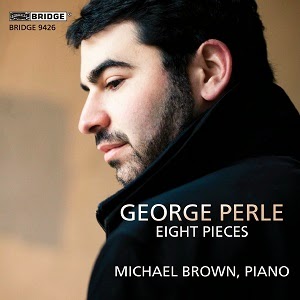
George Perle: Eight Pieces 1938-1997)
Michael Brown, piano
Bridge Records
Every composer should have a champion. For George Perle, that champion is pianist Michael Brown. As a teenaged virtuoso, Brown fell in love with Perle's music and had an opportunity to meet the composer. That developed into a close personal and professional relationship over the years, culminating in this release.
Brown collects not only Perle's published works for solo piano, but some earlier works still unperformed at the time of Perle's death. Brown has a deep understanding of Perle's music, and that makes this collection so exciting to listen to. The eight works span Perle's creative output. The earliest work, the 1938 "Classical Suite" receives it's world premier recording here.
In many ways, it's similar to Prokofiev's "Classical Symphony." While using traditional forms and mostly tonal harmonies, Perle continually plays against expectations as his melodies veer off into unexpected directions.
The "Six Celebratory Inventions" (1989-1997) is the collection that Brown played for Perle as a teenager. Each invention honors a different composer by imitating his style. And while one can hear the dedicatee in each movement -- Leonard Bernstein, Gunther Schuller, Ernst Krenek, et al -- it's all filtered through Perle's inventive imagination, giving this set an overarching sense of cohesion.
Michael Brown has lived with some of these works for a while, and he plays with authority and sensitivity. Perle isn't primarily known for his keyboard compositions. Brown's performances suggest they should be reassessed.
News and views from the classical music announcers at WTJU, 91.1 FM, Charlottesville, Virginia
Showing posts with label Perle. Show all posts
Wednesday, September 17, 2014
Tuesday, March 11, 2014
Daedalus Quartet navigates easily through Perle String Quartets
George Perle
String Quartet 2, 5, & 8
Daedalus Quartet
Bridge
George Perle created what he called "twelve-tone tonality," and the works on this release are all prime examples.
The earliest quartet on the album, Perle's second, also sounds the most tonal -- but that's a relative statement. Even though this is technically written in the key of D minor, the tonal center shifts about quite a bit. All in all, though, a carefully constructed work that moves along to its own internal harmonic logic.
The String Quartet No. 5 seems to continual shift back and forth between tonality and atonality. The underlying serial organization takes the work is somewhat unexpected directions. But its overall tonal character keeps the work grounded, making it sound exotic, rather than beyond the ken.
Perle's String Quartet 8 is more decided atonal in sound, although not entirely so. Perle creates an expressive work with a highly charged emotional atmosphere. Molto Adagio the earliest work on the album (1938), like String Quartet No. 8, seems very much influenced by Schoenberg's Verklärte Nacht. The dissonances are a little sharper in this work, though, giving it a harder edge than the eighth quartet.
The Daedalus Quartet performs these works in a straight-forward, no-nonsense fashion. Vibrato is tightly reigned in, and the ensemble has a clean, precise, transparent sound that admirably serves these works.
String Quartet 2, 5, & 8
Daedalus Quartet
Bridge
George Perle created what he called "twelve-tone tonality," and the works on this release are all prime examples.
The earliest quartet on the album, Perle's second, also sounds the most tonal -- but that's a relative statement. Even though this is technically written in the key of D minor, the tonal center shifts about quite a bit. All in all, though, a carefully constructed work that moves along to its own internal harmonic logic.
The String Quartet No. 5 seems to continual shift back and forth between tonality and atonality. The underlying serial organization takes the work is somewhat unexpected directions. But its overall tonal character keeps the work grounded, making it sound exotic, rather than beyond the ken.
Perle's String Quartet 8 is more decided atonal in sound, although not entirely so. Perle creates an expressive work with a highly charged emotional atmosphere. Molto Adagio the earliest work on the album (1938), like String Quartet No. 8, seems very much influenced by Schoenberg's Verklärte Nacht. The dissonances are a little sharper in this work, though, giving it a harder edge than the eighth quartet.
The Daedalus Quartet performs these works in a straight-forward, no-nonsense fashion. Vibrato is tightly reigned in, and the ensemble has a clean, precise, transparent sound that admirably serves these works.
Subscribe to:
Posts (Atom)

