Showing posts with label Bach. Show all posts

Wednesday, November 5, 2014

The Berlin Wall falls - and a celebration of Dame Joan too!


This Friday, Vivace begins with a delightful piano quartet by Prince Louis Ferdinand of Prussia and a symphony by Antonio Rosetti. 

At 7:30 am, we'll do our part to mark the 25th Anniversary of the fall of the Berlin Wall, which occurs next Sunday, including an excerpt from a rare recording of cellist Mstislav Rostropovich playing at the Berlin Wall as it was being hacked down.  (Incidentally, do join my colleague, John Delehanty who will also mark the occasion on Sunday morning 6-9 am)


Just after 8 am, we have another treat for you: a special feature on the great opera singer, Dame Joan Sutherland on the 88th anniversary of her birth. 


Of course, we'll hear Dame Joan singing for us, and my colleague, Tim Snider, host of the Sunday Opera Matinee, will also offer some insights into her magic. 

As ever, I hope you'll join me for an extra-special edition of Vivace, this Friday, 6-9 am, here on WTJU-Charlottesville.

Tuesday, October 28, 2014

October 31st: It's not just Halloween!

This Friday, there are three special days in one and we'll celebrate them all on Vivace.

Of course, it's Halloween, and we'll enjoy the Symphonie Fantastique in the first hour.  After that, we'll focus on the other two special days: All Saints' Eve and Reformation Day.


At about 7:15 am, we'll hear the beautiful Requiem Mass by Gabriel Faure, as we prepare to remember those who have gone before us.

And after 8 o'clock, we have two special works for Reformation Day.  First, we'll hear the Bach Cantata, Ein feste Burg ist unser Gott, BWV 80, based on the original hymn by Martin Luther, and we'll end with The Reformation Symphony by Mendelssohn.


I hope it will be a spectacular morning of music, something a little different for October 31st - just what you've come to expect from WTJU!  As ever I look forward to the pleasure of your company for Vivace, right here on WTJU-Charlottesville.

Saturday, June 7, 2014

Start the week on a lively note!

Start your week on a lively note when I'll be filling in for John on Dawn's Early Light.  As ever the program opens with music of Bach, this week, the English Suite No.1 in A-Major, BWV 806.


They'll both be on the show.

At 7 am, we'll celebrate our first birthday of the day with music by Otto Nicolai, most famous, perhaps, for being the founder of the Vienna Philharmonic. As well as hearing music by Glazunov and Corelli, we'll also celebrate the birthdays of the London Symphony Orchestra, Danish composer Carl Nielsen - and, just before 8 o'clock, the 80th birthday of America's most-beloved Anatine-American.

After 8 o'clock, we'll have a symphony by Johann Stamitz, a piano sonata by Mozart and there's one more birthday to celebrate: that of a great 20th Century American composer.

I hope you'll join me bright and early for Dawn's Early Light, this Monday morning, 6-9 am, right here on WTJU-Charlottesville.

Thursday, March 27, 2014

A joyful, tuneful way to start your Friday


This week's Vivace begins with another in our occasional series of rarely-heard symphonies by Sir Hubert Parry: the Symphony No. 3 in C-Major, "The English" symphony. 


After 7 o'clock, we'll hear one of those fine flute concertos by Antonio Rosetti, and a Mozart horn concerto - some delightfully tuneful melodies. 

In the 8 o'clock hour, we have a rarely-heard Trumpet and Oboe Concerto by Johann Hertel, as well as music by Salieri and Sarasate, and an unusual arrangement of a well-loved favorite by Johann Sebastian Bach. 

As ever, I look forward to the pleasure of your company on Vivace, 6-9 am, right here on WTJU-Charlottesville.

You can also replay the program anytime from the WTJU archives. This program will be available for replay through 4/11/14.

Wednesday, March 19, 2014

Celebrating JS Bach and three other musical birthdays!

On March 21st, 1685, Johann Ambrosius Bach, the director of the musicians of Eisenach in Germany, and his wife, Maria Elisabeth, welcomed their eighth child, Johann Sebastian Bach. 


Less than a month earlier, Georg Frederic Handel had been born less than 100 miles away.  The two boys grew up to be the guiding musical lights of the Baroque period.   We'll celebrate Bach's birthday in fine style this week on Vivace.

There are also three other remarkable anniversaries:  the debut of the Great Symphony No.9 in C-Major, by Schubert, a performance of which will fill our first hour;  the first performance of the String Quartet No. 13 in B Flat Major, by Beethoven, which we'll hear after 8 o'clock, and the 75th anniversary of one of the most famous songs of the modern era.  We'll also have a piano concerto by Puccini, but not the Puccini you know.

As ever, I hope you'll join me for a show full of entertainment and surprises.  That's Vivace, this Friday, March 21, 6-9 am right here on WTJU-Charlottesville.

Wednesday, January 22, 2014

Warm, lively and regal!

We'll try to keep you warm and happy this Friday on Vivace.

Much of our first hour is music from nice, warm Spain, the Suite Espanola by Isaac Albeniz.

At 7 o'clock, we'll have a concerto from a popular composer, Josef Fiala, and a light-hearted work by Mozart.


After 8 o'clock, we will be putting on our very best outfits for some very regal music. We'll play a symphony written by a reigning European king, and then an overture conducted by another reigning European king! Music by Bach and Elgar will round out a warm, lively and regal edition of Vivace.

As ever, I look forward to the pleasure of your company, this Friday, 6-9 am, right here on WTJU-Charlottesville.

You can also replay the program anytime from the WTJU archives. This program will be available for replay through 2/7/14.

Wednesday, October 30, 2013

All Saints Day: A Vivace celebration

This Friday is All Saints Day and Vivace will celebrate the occasion with some special music.

We start at around 6:45 am with Four Little Prayers of St. Francis of Assisi by Francis Poulenc.


At 7 o'clock, we have the very familiar St. Anthony Chorale by Haydn, and the St. Anne Prelude and Fugue by Bach.  After 7:30, we have another real treat for you: music composed by St. Francis of Assisi himself.

In the 8 o'clock hour, we have a lovely - and surprising - variety of music connected with saints, including compositions by Arvo Part, Vaughan Williams and Mozart. 

As ever, I look forward to the pleasure of your company as we celebrate All Saints Day - Vivace style, Friday, 6 -9 am on WTJU.

Wednesday, July 24, 2013

Helmuth Rilling Personal Selection: Indeed the best of the best

Helmuth Rilling Personal Selection
10 CD Set
Hänssler Classic

Conductor Helmuth Rilling has enjoyed a long and productive relationship with the Hänssler Classic. To celebrate Rilling's 70th birthday, Hänssler released this 10-CD set, Rilling's hand-picked favorites from the over 240 recordings he's made with the label. With that much material to choose from, it's safe to say this set is indeed the best of the best.

Rilling is perhaps best known for his traversal of Johann Sebastian Bach cantatas and oratorios. That cycle is well-represented in this collection. In addition to the St. John Passion and the "Peasant" Cantata, there are also some shorter works by Bach in the set.

Rilling takes a straight-forward approach to Bach. He tends to keep things moving briskly along, with tight, clean ensembles that make the counterpoint easy to follow. Rilling lets the music speak for itself, and in these recordings, it has a lot to say.

That same type of unadorned, no-nonsense direction is equally effective in Rilling's recording of the War Requiem by Benjamin Britten.

The collection includes many works by romantic masters, and Rilling adjusts his style appropriately. César Franck's Les Béatitudes shimmers with a soft glow. Rilling lingers lovingly over each beautiful turn of phrase in Schubert's Gesang der Geister. His performance of Bruckner's Te Deum is emotive, with just the right amount of gravitas and portent.

Also featured in the collection is Haydn's Harmoniemess in B-flat. Rilling's precise interpretation captures the classical era's ideal: the perfect balance between form and emotion. Mendelssohns' Heimkerh aus der Fremde is full of good humor. The work was written for private performance (to celebrate an anniversary), and Rilling maintains a light hearted and casual mood throughout this seldom-heard work.

Hänssler's crystal-clear recording techniques perfectly match the style of this remarkable conductor. If you're not familiar with Helmuth Rilling, this collection is an excellent place to start. It spans a good portion of his time with Hänssler, and shows a remarkable consistency of quality throughout.

Wednesday, December 12, 2012

Bach's Evenings at Zimmerman's Coffeehouse

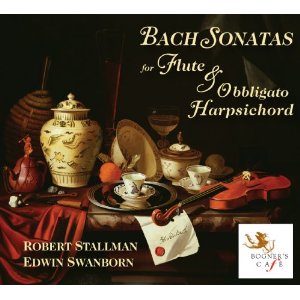
Bach Sonatas for Flute & Obbligato Harpsichord
Evenings at Zimmermann's Coffeehouse
Robert Stallman, flute, Edwin Swanborn, harpsichord
Bogner's Cafe

The subtitle of this release aptly describes the disc. In 1730's J.S. Bach spend a significant amount of time at Zimmermann's Coffeehouse in Leipzig. It was one of the regular performing venues for the Collegium Musicum, which he directed (and wrote music for). Most of his instrumental music of this period were written for this group, including the four flute sonatas in this release. By no means are these major works. Of course, it is Bach, so the sonatas are well-crafted, but the music is intentionally light and simple. This is more the Bach of "Air on G String" than the Bach of the Cello Sonatas.

Robert Stallman performs on a modern flute, but that just gives the works additional charm. The music mostly stays in the lower part of the flute's register, and Stallman produces a very warm sound on his instrument. The result is some attractive playing and a pleasant listening experience overall. Edwin Swanborn provides tasteful accompaniment on the harpsichord. The keyboard obbligato helps move the music along without sounding overly busy or fussy. An attractive program of music played with just the right tone to keep the proceedings light and entertaining -- as perhaps they were in Zimmermann's over three centuries before.

Friday, June 15, 2012

"Fathers and Sons of the Bach Family"

Father’s Day is this Sunday, 17 June. To mark the occasion, on Classical Sunrise that morning (6 to 9 AM), I’ll be doing a show titled “Fathers and Sons of the Bach Family.” 

Of course you can expect to hear music of Johann Sebastian Bach and his sons, but I will also be featuring works from other lesser-known members of this extraordinary family. The Bach line of professional musicians spans over six generations. 

According to the family chronicles, Veit Bach, a baker by trade (d. ca. 1576), was the forefather of this dynasty and the first to show musical proclivities. His son Hans (d. 1626) was the first known professional musician, and his three sons in turn established different branches of the Bach family of musicians. 

Among other samplings, we’ll hear music of Heinrich Bach (1615-1692), son of Hans and founder of the Arnstadt line, and that of his son Johann Michael Bach (1648-1694). We’ll explore the music of Johann Bach (1604-1673), also the son of Hans, and the founder of the Erfurt line of the family, and listen to music of Johann’s great grandson, Johann Ernst Bach (1722-1777). 

In my mind, no day is complete without the music of JS Bach, and with 20 children to his name (10 of which survived to adulthood), JS Bach is perhaps the musical epitome of Fathers and Sons. 

So tune in to Classical Sunrise this Sunday, 17 June 2012, on WTJU Charlottesville, 91.1 FM, and streaming live on www.wtju.net, to celebrate the music of the most important family in the history of Western music.

And if you missed the program, you can hear it again on-demand anytime over the next two weeks at our Virtual Tape Vault.

Saturday, March 10, 2012

Happy 327th Birthday, Johann Sebastian Bach (21 March 2012) (1685-1750)

Bach's final unfinished fugue.
Over the next three Sunday mornings on my show Classical Sunrise (6 to 9 AM EDT), I will be featuring J.S. Bach’s monumental works: Die Kunst der Fuge, BWV 1080 (The Art of Fugue); the Mass in B minor, BWV 232; and the St. Matthew Passion, BWV 244; three of the greatest classical works of all time.

Bach was the undisputed master of fugal writing, and the Art of Fugue is the culmination of his skill and artistry. The work consists of 14 fugues and four canons. The inventiveness and genius of the piece is breathtaking. It was his last major composition; Bach died before he could complete it. The abrupt ending in the middle of the last fugue, and the profound silence thereafter, speaks to my soul in a way that no other single piece of music can match.

Bach’s Mass in B Minor, BWV 232, is in some ways the vocal equivalent of the Art of Fugue: the Mass was his last choral composition, representing the crowning achievement in this genre. He completed it in 1749, the year before he died, although parts of it were composed decades earlier.

Bach’s setting of the Passion According to St. Matthew, BWV 244, was composed for Good Friday 1727 in Leipzig. Every year at St. Thomas Church in Leipzig, a Passion traditionally was performed on Good Friday. It was the high point in the church calendar, particularly coming as it did after Lent during which no music was performed in the church. Bach, as a cantor at St. Thomas church, had earlier composed the St. John Passion, BWV 245, but it lacked the unity that Bach achieved in the St. Matthew Passion. Only these two Passions survive of the five passions that were mentioned in his obituary. The St. Matthew Passion, known as the “Great Passion,” in Bach’s family, according to Christoph Wolff, surpassed all that Bach had previously composed in sacred music.

Bach’s compositions were all intended for the glory of God. Perhaps nowhere is Bach’s intention more evident than in these three grand-scale pieces.

Friday, March 19, 2010

JS Bach's 325th Birthday on Sunday, 21 March 2010

This Sunday, 21 March 2010 marks the 325th anniversary of the birth of Johann Sebastian Bach, who, in my opinion, is the greatest composer of all time. We will be celebrating this anniversary on Classical Sunrise on Sunday from 6 to 9 am with an all-Bach program.

Starting at 6 am (EDT), I will be playing the great Mass in B minor, which was completed in his last years, around 1748-1749. His plans regarding the mass started much earlier with the layout of the Kyrie-Gloria Mass of 1733, when he thought of composing a complete setting of the mass.

Many parts of the Mass in B minor are drawn from earlier works, including the Sanctus, which was orginally written for Christmas 1724; the Osanna, which was derived from a secular cantata movement from 1732; and the Agnus Dei, derived from a cantata movement from 1725. The B minor mass represents the pinnacle and summation of Bach's vocal works.

Among other works of Bach that we will hear on Sunday, I will also play the Cantata BWV 69, Lobe den Herrn, meine Seele (Praise the Lord, O my Soul), written for the election of a new Town Council in Leipzig. This work also borrowed in part from another cantata.

Friday, February 19, 2010

No Bach Cantatas during Lent

There were no cantatas performed in the Lutheran church in Leipzig during Lent in the time of JS Bach.

Don't despair, however, because we will listen to the only surviving cantata from Bach's Weimar years that was likely performed on the Third Sunday in Lent, 24 March 1715: BWV 54, Widerstehe doch der Sunde (Resist sin indeed). So tune in to Classical Sunrise during the 6 am hour on 7 March to hear this performed.


The only other Bach cantata that would have been performed during Lent (depending on when Easter falls) would have been a cantata for the Feast of the Annunciation of the Blessed Virgin Mary, on 25 March. And, you can expect something special on Classical Sunrise (perhaps the B minor Mass) on Bach's birthday, Sunday 21 March.

Thursday, February 11, 2010

JS Bach Cantata for Esto mihi Sunday (the Sunday before Lent)

This Sunday, 14 February 2010, on Classical Sunrise during the 6 am hour, I will be playing JS Bach's church cantata, BWV 22, Jesus nahm zu sich die Zwolfe (Jesus took the Twelve to Him). Esto mihi ("Be with me," after Psalm 31) Sunday or Quinquagesima is the Sunday before Lent.


This cantata dates from 1723, and along with Cantata 23, was composed for Bach's audition on 7 February 1723 for the post of Thomaskirche Cantor in Leipzig. A score of the cantata includes the inscription "Dies ist das Probestuck in Leipzig." (This is the Leipzig trial-piece.) Cantata 22 is tied to the Sunday Gospel, Luke 18, dealing with Jesus's journey with the twelve disciples to Jerusalem. Cantata 22 ends with a four-part chorale. And, as we know, Bach passed the audition.

During his years at Leipzig, and particularly in the first few years, Bach had to compose a new cantata each week (and then have it copied into parts, rehearsed, and ready to perform). The first Leipzig cycle of Bach church cantatas officially began with his installation as Cantor of St Thomas church on the first Sunday after Trinity 1723. The church cantata was sung after the Gospel and before the Lutheran creed. If the cantata were in two parts, the second part was performed after the sermon or during Communion.

Thursday, February 4, 2010

JS Bach cantatas for Sunday, 7 February 2010

This Sunday, 7 February, on "Classical Sunrise" (6 am to 9 am EST), I'll be featuring two JS Bach church cantatas: BWV 144, Nimm was dein ist, und gehe hin (Take what is yours and go your way), and BWV 18, Gleichure der Regen und Schnee vom Himmel fallt (Just as the rain and snow fall from Heaven)(probably fairly apt given the predictions of snow for this weekend). The first is for Septuagesima, that is the Third Sunday before Lent, and was first performed on 6 February 1724, during Bach's first year in Leipzig. The latter dates most likely from 19 February 1713 during Bach's Weimar years. The text is by Erdmann Neumeister.


According to "The Cantatas of J.S. Bach," by Alfred Durr (translated by Richard DP Jones), Bach composed 5 cycles of cantatas for the liturgical calendar, but only 3 cycles survive almost intact, with a few other sacred cantatas. The earliest Bach cantata that is known dates from his Mulhausen period (roughly 1707). The year 1713, the year BWV 18 likely was composed, also coincides with the first secular cantata of JS Bach (as far as we know).

I hope you are enjoying this presentation of JS Bach sacred cantatas matched to the liturgical calendar. Deborah

Friday, January 29, 2010

Bach Cantatas on "Classical Sunrise"

This Sunday, 31 January, on "Classical Sunrise," I'll be featuring two JS Bach cantatas: Cantata for the 3rd Sunday after Epiphany, BWV 111, Was Mein Gott will, das gscheh allzeit, and Cantata for the 4th Sunday after Epiphany, BWV 81, Jesus schlaft, was soll ich hoffen.

BWV 111 was composed for 21 January 1725. The four-verse hymn on which it is based incorporates verses by Duke Albrecht of Prussia (1547, 1554). The anonymous librettist for BWV 81 takes the text from the Gospel of Matthew, 8:23-27 (Jesus, sleeping in the boat, is awakened and calms the storm). This cantata dates from Bach's first Leipzig cycle of cantatas, and was composed for 30 January 1724.

I'll be airing a recording featuring the Holland Boys Choir and the Netherlands Bach Collegium, conducted by Pieter Jan Leusink. The soloists for BWV 111 are Ruth Holton, soprano, Sytse Buwalda, alto, Nico van der Meel, tenor, and Bas Ramselaar, bass.

For BVW 81, the featured soloists are Sytse Buwalda, Knut Schoch, tenor, and Bas Ramselaar. This is a complete set of Bach sacred cantatas, on the Brilliant Classics label. This is the second year in which I am featuring Bach cantatas for the entire liturgical calendar on "Classical Sunrise."

 - Deborah Murray

Friday, December 18, 2009

Holiday Programming - Classical Sunrise

Sunday, Dec. 20 a special edition of Classical Sunrise begins at 6 AM on WTJU, 91.1fm (heard online at wtju.net). Host Deborah Murray will be presenting Johann Sebastian Bach's "Christmas Oratorio," BWV 248.

The work consists six parts, one for each of the six feast days of Christmas. This massive oratorio was premiered on Christmas day, 1734 in Leipzig. Although meant to be performed over several Sundays, the organization and overarching structure of the music indicate that Bach thought of the "Weihnachtsoratoirum" as a unified whole.

Which is just the way Deborah's going to present it!

Wednesday, September 16, 2009

Bach: Crab Canon Visualized

Music may be an audible art form, but sometimes visuals can help, too. Jos Leys, who normally works in the field of mathematics, has created a short film illustrating Bach's "Crab Canon" from the "Musical Offering" in action.

Now, I could tell you that what makes this composition such a tour-de-force is its simple complexity. A crab canon, or cancrizan, is sort of like a round. A melody starts off, and then the second voice comes in a few beats later, and this single tune layered against itself creates the harmony (like "Row, Row, Row Your Boat).

But a crab canon has the second voice enter with the melody in reverse. So the art is to construct a tune that makes sense forwards and backwards - and can harmonize with itself in the process. Hard to understand? I agree. That's why I like this video. View, and enjoy.