Richard Danielpour: Darkness in the Ancient Valley
Nashville Symphony; Giancarlo Guerrero, conductor
Angela Brown, soprano
Hila Plitmann, soprano
Naxos
Darkness in the Ancient Valley is Richard Danielpour's attempt to return to his Persian heritage. The basis for this five-movement symphony is a 16th century Iranian poem.
To my ears, the opening movement sounds like film music trying to evoke a Middle Eastern setting. But as the work progresses, pastiche gives way to passion, and the music develops its own blended and original voice. The final movement for orchestra and soprano (Hila Plitmann, for whom the part was written) brings the work home with an emotional and transcendent finale.
Rounding out the release are two other orchestral works. Lacrimae Beati sounds a little like Copland with its open intervals. Although based on the first eight bars of Mozart's Requiem (reportedly the last music he ever wrote), Danielpour so completely integrates the source material that there's almost no trace of the original composer. And that's a good thing -- this is a deeply personal work, a musing on mortality. It would be jarring to Mozart's music stick out from the rest of the composition.
A Woman's Life, a setting of eight poems by Maya Angelou, has a distinctively American feel to it. But it's not Copland Americana. While the harmonies may sound similar, the rhythm of the words and the melodic seem to recall African-American gospel traditions. The work was composed for soprano Angela Brown, and her performance here infuses the words with understated drama and urgency. A beautiful orchestral song cycle that deserves a place in the repertoire.
News and views from the classical music announcers at WTJU, 91.1 FM, Charlottesville, Virginia
Tuesday, December 31, 2013
Monday, December 30, 2013
Jean Maillard: A renaissance composer rediscovered
Jean Maillard:
Missa Je Suis Deheritee & Motets
The Marian Consort; Rory McCleery, director
Delphian Records
Jean Maillard was a student of Josquin des Prez, and his music inspired Palestrina. Although little-known today, this French composer's music was highly regarded by his contemporaries. And listening to these performances by the Marian Consort, it's easy to understand why.
Maillard carefully and tastefully builds his contrapuntal compositions in a manner similar to Palestrina, although with a lighter touch. The primary work on this album, the Missa Je suis Desheritee is one of Maillard's largest works, and the most popular during his lifetime. It, like the motets interspersed throughout, show a composer in full command of his talent, able to create ethereal cathedrals from pure sound.
The Marian Consort has a uniform clarity of tone that's well-suited to these works. The ensemble blend is quite smooth throughout, although at times the sopranos seemed to have a slight edge to their voices (especially after a wide upwards leap).
All in all, though, this is a disc that should be in the collection of anyone who loves renaissance sacred music. Maillard may be the link between Des Pres and Palestrina, but he has a style all his own.
Friday, December 27, 2013
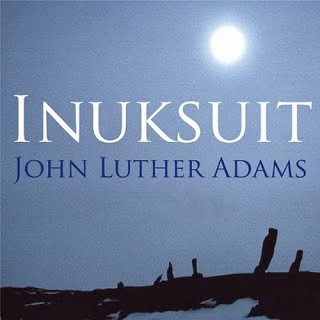
Inukusuit - Soundscapes by John Luther Adams
Inukusuit
John Luther Adams
Cantaloupe
If I had to describe Inukusuit, I’d say it sounds like Edgar Varese’s “Ionization” performed in the woods. But that really doesn’t do justice to Adams’ innovative soundscape. Inukusuit is a work intended for outdoor performance The ambient sounds are an important part of the composition, making every performance unique.
Be warned: Inukusuit require a major time investment (about an hour) to be experienced properly. But it will be worth the effort.
The recording starts with about three minutes of ambient sounds of the forest, before the percussion ensemble makes its presence known. Eventually the ensemble builds to a climax, completely drowning out the sounds of nature. Then the man-made music subsides, and in the end, we are left with only the chirping of birds and wind rustling the trees.
Adams’ music seems an organic part of the landscape. There’s a lot of wooden percussive sounds (including a wooden flute), and the ensemble seems to rise and fall, as if breathing. The disc comes with both an audio CD and a DVD version. And that’s a good thing. Because the DVD, played through a 5.1 home theater system, will get you as close as possible to the performance – which, after all, involves heightening the listener’s sense of space.
Subscribe to:
Posts (Atom)