Tuesday, December 16, 2014

The Vivace Christmas Special

This Friday, we'll broadcast the Vivace Christmas Show, a mixture of classical and Christmas music. 


We start with the Czech Christmas Eve Mass by Jan Ryba, a perennial favorite, followed by some piano music by Beethoven.

We'll devote the first part of the 7 o'clock hour to Suites 3 and 4 of The Many Moods of Christmas, the seminal 1963 work by Robert Russell Bennett. We have the 1983 recording by the Atlanta Symphony Orchestra and Chorus.  

After concertos by Albinoni and Vivaldi, we have the brand-new best-selling recording of Angels from the Realms of Glory by cellist Steven Sharp Nelson and The Piano Guys.

There's more Christmas music in the 8 o'clock hour, culminating, as usual with selections from Messiah by Handel.  

You're most welcome to sing along, but above all, I hope you'll join me here on WTJU-Charlottesville for Christmas Vivace, Friday morning, 6-9 am.  And finally, let me wish you and all those you love a peaceful, joyful Christmas and a very happy new year.

Monday, December 15, 2014

Deborah Murray's finale on Classical Sunrise

This Sunday, please remember to tune in to Classical Sunrise, 6-9 am, here on WTJU-Charlottesville.

After 15 years, Deborah Murray is bowing out as host of the program, and this will be her last show.

Deborah has been an outstanding station volunteer, not only hosting a program, but also serving as Classical Department Director. She has overseen the classical programming on WTJU, and helped guide it through difficult times. She's also organized the classical department's fund-raising marathons and has been personally responsible for bringing in generous contributions from her listeners.

Most important, though, is that Deborah has carefully and thoughtfully chosen every work she's aired over the last decade and a half. That care and attention to detail has made "Classical Sunrise" part of many listeners' Sunday morning routine.

We know she has a special show planned in appreciation of all of you who have enjoyed joining Deborah on Sunday mornings.  We hope you'll tune in. And please call in to wish her well!   


Wednesday, November 5, 2014

The Berlin Wall falls - and a celebration of Dame Joan too!


This Friday, Vivace begins with a delightful piano quartet by Prince Louis Ferdinand of Prussia and a symphony by Antonio Rosetti. 

At 7:30 am, we'll do our part to mark the 25th Anniversary of the fall of the Berlin Wall, which occurs next Sunday, including an excerpt from a rare recording of cellist Mstislav Rostropovich playing at the Berlin Wall as it was being hacked down.  (Incidentally, do join my colleague, John Delehanty who will also mark the occasion on Sunday morning 6-9 am)


Just after 8 am, we have another treat for you: a special feature on the great opera singer, Dame Joan Sutherland on the 88th anniversary of her birth. 


Of course, we'll hear Dame Joan singing for us, and my colleague, Tim Snider, host of the Sunday Opera Matinee, will also offer some insights into her magic. 

As ever, I hope you'll join me for an extra-special edition of Vivace, this Friday, 6-9 am, here on WTJU-Charlottesville.

Monday, November 3, 2014

Mercandante "I Briganti" anticipates Verdi

Saverio Mercandante: I Briganti
Maxim Mironov; Petya Ivanova; Vittorio Prato; Bruno Pratico; Camerata Bach Choir, Poznan; Virtuosi Brunensis; Antonio Fogliani, conductor
Naxos


Saverio Mercandante has been characterized as the bridge between Rossini and Verdi -- and I Briganti demonstrates why. Completed in 1836, "I Briganti" was written partially in response to Bellini's "I Puritani."

This bel canto opera eschews self-contained arias for music that is more fully integrated into the drama. At the same time, it provides plenty of opportunities for singers to show what they're made of -- as is the case in this performance.

This world premier recordings captures the 2012 Rossini in Wildsad Festival production, with all pros and cons of live recording. The pros include the singing of the three principals, tenor Maxim Mironov (Ermano), baritone Vittorio Prato (Corrado), and soprano Petya Ivanova (Amelia). All three sing with confidence and energy, producing warm, rounded tones.

The cons include some occasional pitch problems in the chorus, and the overall recorded sound. The sound stage seems a little cramped, and the music sounded to my ears somewhat soft around the edges.

Nevertheless, Mercandante's music works its magic and I soon forgot my quibbles with the recording. Highly recommended for lovers of Italian opera. And if you can, listen to "I Briganti" and then Verdi's "I Masnadieri," a setting of the same story. Mercandante's opera compares quite favorably, particularly in dramatic structure and pacing.

Saturday, November 1, 2014

Our New Classical Schedule

We're delighted to announce WTJU's new schedule for classical music.  Most of your favorite shows remain unchanged, but we have a few new goodies for you. 

Novitas has replaced The Listening Room as our Wednesday evening show devoted to 20th and 21st Century music.  John Delehanty, who has a great deal of knowledge about modern music, will be bringing his expertise as he moves from Monday mornings to be the new host of Novitas. 

Dawn’s Early Light will end on November 24, and after the Classical Marathon (December 1-7), it will be replaced by a new Monday morning show, Top Of The Morning, hosted by Andrew Morgan, which will begin on December 8.

On Friday evenings, Melodiya has ended and is being replaced with Fridays At Six, which is really two shows in one.  Starting on November 7, on alternate Fridays, Thom Pease brings his vast knowledge of the musical theater to present On With The Show, a program featuring music from Broadway musicals, operetta and anything else Thom finds to entertain us.  And on the other alternate Fridays, Julie Fowler presents Shaken, Not Stirred, a delightful mixture of joyful classics and film music to help you relax at the end of the week.  Francesca will be joining Deborah Murray to host Classical Sunrise on Sunday mornings.

Our Weekday Morning Hosts:
L-R: Andrew Morgan (Mondays), Allen Hench (Tuesdays), Ralph Graves (Wednesdays), Campbell Shiflett (Thursdays) and Steve Myers (Fridays)

We hope you'll enjoy the new program schedule. We always love to hear your comments and suggestions.  Here's the new classical lineup, as it will be after December 8: 

Sundays
6-9 am Classical Sunrise: Deborah Murray and Francesca
2-6 pm The Sunday Opera Matinee: Ann Shaffer, Tim Snider & Allen Hench
6-7 pm The King of Instruments/Evensong: Michael Latsko
7-9 pm Just A Few Friends: Penelope Ward

Mondays
5-6 am Classical Prelude
6-9 am Top Of The Morning: Andrew Morgan
6-8 pm The Early Music Show: Greg Cox

Tuesdays
5-6 am Classical Prelude
6-9 am La Belle Musique: Allen Hench
6-8 pm A Time For Singing: Ann Shaffer

Wednesdays
5-6 am Classical Prelude
6-9 am Gamut: Ralph Graves
6-8 pm Novitas: John Delehanty

Thursdays
5-6 am Classical Prelude
6-9 am Classical Cafe: Campbell Shiflett
6-8 pm Intermezzo: The Contessa and Andrew Pratt

Fridays
5-6 am Classical Prelude
6-9 am Vivace: Steve Myers
6-8 pm Fridays At Six:
On With The Show: Thom Pease
Shaken, Not Stirred: Julie Fowler

Tuesday, October 28, 2014

October 31st: It's not just Halloween!

This Friday, there are three special days in one and we'll celebrate them all on Vivace.

Of course, it's Halloween, and we'll enjoy the Symphonie Fantastique in the first hour.  After that, we'll focus on the other two special days: All Saints' Eve and Reformation Day.


At about 7:15 am, we'll hear the beautiful Requiem Mass by Gabriel Faure, as we prepare to remember those who have gone before us.

And after 8 o'clock, we have two special works for Reformation Day.  First, we'll hear the Bach Cantata, Ein feste Burg ist unser Gott, BWV 80, based on the original hymn by Martin Luther, and we'll end with The Reformation Symphony by Mendelssohn.


I hope it will be a spectacular morning of music, something a little different for October 31st - just what you've come to expect from WTJU!  As ever I look forward to the pleasure of your company for Vivace, right here on WTJU-Charlottesville.

Monday, October 27, 2014

Paul Hindemith: Nobilissima Visione

Paul Hindemith: Nobilissima Visione
Seattle Symphony; Gerard Schwarz, conductor
Naxos


The 1936 ballet "Nobilissima Visione" is the story of St. Francis. Hindemith crafted the music from folk songs, and combined them with the same rich spiritual language he used for his opera "Mathus der Maler" (completed just a year before). "Nobilissima Visione" paints each scene in vivid orchestral colors, and Hindemith effectively conjures up a quasi-medieval world with a distinctively modern orchestra.

Also included is the instructional work "Five Pieces for String Orchestra, Op. 44, No. 4" Hindemith wrote it for beginning and intermediate string players, but one would never know it just by listening to the work. While keeping the technical demands simple, Hindemith creates a varied collection of movements of truly substantial music.

The Seattle Symphony is in fine form on this album. Directed by Gerard Schwarz, the orchestra seems to relish the finely-wrought textures of the scores, sometimes seeming to linger over especially luscious passages. The ensemble is tight throughout both works, and the string sound is gorgeously expansive, especially in the "Five Pieces." If you like Hindemith's "Mathus der Maler" symphony, or "The Four Temperaments," you'll find much to enjoy in this release.

Wednesday, October 22, 2014

Your Friday Breakfast Buffet: Enchanting Music!

Nino Rota and Christoph Weyse
We have a superb buffet of Friday morning music for you on this week's Vivace.

We begin with music of Italian composer Nino Rota, his Symphony of Love Songs, followed by the delightful Morning Songs by Danish composer Christoph Weyse. 
 
At 7 am, we'll hear one of those splendid rondos by Prince Louis Ferdinand of Prussia, as well as an enchanting harp sonata by Krumpholz and a symphony by Jan Zach. 

Later in the hour, we'll have another tranquil tunes sequence, and a celebration of two anniversaries from the world of operetta.

Emmerich Kalman: one of our birthday celebrants
At 8 o'clock, we'll make a short visit to the world of opera and we'll end with music of Mozart and Ernst von Gemmingen Hornberg.  Who was he?  Well, tune in and you'll find out!

As ever, I hope you'll join me for Vivace, this Friday, 6-9 am, right here on WTJU-Charlottesville.

Monday, October 20, 2014

Norgard Symphonies Nordic Masterworks

Pers Norgard: Symphonies Nos. 1 & 8
Vienna Philharmonic Orchestra
Sakari Oramo, conductor
Dacapo SACD


Sakari Oramo has paired Pers Nørgard's first symphony (1953) and his most recent symphony (2011) together, creating an interesting study in contrasts. To my ears, there's a certain Nordic quality to both works. Although the 8th is more dissonant and not as tonal in structure, neither work falls neatly into the post-romantic or atonal categories. Like Sibelius, Norgard has charted his own path and created his own musical language that draws somewhat from both camps.

Nørgard greatly admired Sibelius. He corresponded with the older composer, shared some scores with him, and dedicated his first quintet to Sibelius (with permission). The Symphony No. 1 suggests that Nørgard is indeed one of the heirs of Sibelius' ascetic.

The work has an icy coolness to it, mostly due to Nørgard's orchestration. His string writing, particularly, seems to favor the treble, giving it somewhat of an edge. The subtitle, "Sinfonia Austera," puts the listener on notice, and Nørgard indeed delivers an austere work that nonetheless is quite moving in parts (particularly the slow movement).

Nørgard's 8th Symphony is the work of a mature composer thoroughly in command of his materials. Like the first, it doesn't necessarily fit into the current compositional schools. Instead, Norgard constructs his own sonic world that sounds contemporary without being trendy. The glittering chromaticism and unusual instrumentation make it a work both in and out of its time. If you purchase the SACD of this release, be sure to play it through an SACD player -- the greater detail I heard made a significant difference in the impact this symphony had on me.

Pers Nørgard is well-regarded throughout Scandinavia. Perhaps this recording will help spread his reputation even further.

Wednesday, October 15, 2014

A Morning of Marvelous Musical Treats!


This Friday on Vivace, we have some special musical treats for you. 

We start gently at 6 am with a Sonata for Flute and Piano by Danish composer Friedrich Kuhlau and, for viola fans, a viola concerto by Carl Stamitz. We will also salute British composer Herbert Howells on his 122nd birthday - appropriately with his arrangement of Psalm 122.


Herbert Howells and Domenico Zipoli

At 7, we find Franz Schubert in lively mood as we listen to his Five German Dances, and we'll also have a short work by Domenico Zipoli, whose 326th birthday will be on Friday.

      Felix Mendelssohn at 22

On October 17, 1831, the 22 year-old Felix Mendelssohn gave the first performance of his Piano Concerto No. 1 in G, Op. 25 in In Munich. To commemorate the occasion we'll hear it at about 7:30 am, in a sparkling performance by Sir Andras Schiff, who returned to the same hall in Munich to perform it with the Bavarian Radio Symphony Orchestra. 

The real star of this week's show may well turn out to be the Cello Concerto No.6 by Jean Balthasar Tricklir, which we'll hear just after 8 am. We're anticipating a good audience reaction, so here's a photo of the CD cover, just in case you want to buy it.

We'll round out the show with music of Hummel and Mozart. As ever, I hope you'll join me for Vivace, 6-9 am Friday, right here on WTJU-Charlottesville.

Monday, October 13, 2014

The Tudors at Prayer

The Tudors at Prayer
Byrd, Tallis, White, Munday, Tavener
Magnificat; Philip Cave, director
Lynn


Though the theme is somewhat narrowly defined, (English sacred music 1560-1590), there's a surprising amount of variety in this program. Henry VII created the Anglican church, though it had very little change on the sacred music John Tavener and Thomas Tallis composed.

His daughter, Mary I, reinstated the Catholic church, and the music of her time by William Munday and Robert White, reflect that return to tradition. Elizabeth I, like her father an ardent music-lover, brought back the Anglican church, and the sacred music of her time seems more cosmopolitan, somehow. The sacred works of William Byrd don't follow quite follow tradition as closely.

Magnificat performs all these works with appropriate interpretation, making it easier to hear the subtle differences between works written for monarchs with conflicting agendas.The sound is spacious, as befitting the chapels and cathedrals for which these works were written, with just enough ambiance to make the ensemble sound full, without obscuring the contrapuntal lines within.

Wednesday, October 8, 2014

Vivacious music and an interview with Jon Nakamatsu!

This Friday, on Vivace, we'll feature a new recording of Alessandro Rolla's Basset Horn Concerto, a work I played back in April.  This is a great recording and I know you'll enjoy it.

We celebrate the birthdays of pianist Evgeny Kissin and of composer Giuseppe Verdi.


Also, there's plenty of music for Mozart lovers!

At 8 o'clock, we have a short interview with pianist Jon Nakamatsu, who will be appearing in Charlottesville next Tuesday, as part of the Tuesday Evening Concert Series.


As ever, I hope you'll join me for Vivace, this Friday 6-9 am, here on WTJU-Charlottesville.

Monday, October 6, 2014

Lassus Musical Biography Maintains High Standards with Volume 3

Roland de Lassus: Musical Biography, Vol. 3
Egidus Quartet and College
Peter de Groot, director
MEW


You'll come for the music, but stay for the biography. The third volume of WEM's excellent series couples first-rate performances of Lassus' music with an in-depth biography that places that music in context.

This volume focuses on the year 1583, when Lassus' relationship with his sponsor,  Albrecht V Duke of Bavaria, was starting to unravel. The music from this time is mostly sacred, featuring the Missa O passi sparsi, along with several motets and the Magnificat supra Las je n'iray.

The Egidius Quartet wisely inserts several "sine textu" instrumental works throughout the program. It provides some tonal variety, and makes the disc enjoyable to listen to straight through. The Egidua Quartet and College perform with pure singing tones that give the selections a luminous transparency.

The release comes with a 62 page hard-bound CD book with color illustrations. It's as much a joy to read as the music is to listen to. Granted, this release will most likely appeal to only hardcore early music lovers. But if you're one of them, this -- and the rest of the series -- is worth the investment.

Monday, September 29, 2014

Andrew Manze Leads Lars-Erik Larsson Revival

Lars-Erik Larsson: Symphony No. 2
Orchestral Works, Vol. 1
Helsingborgs Symfonionkester
Andrew Manze, conductor
CPO SACD

Swedish composer Lars-Erik Larsson is not well-known outside of his native country, but this new series from CPO may change that. Larsson is part of the generation immediately following Sibelius, and follows him stylistically as well.

Larsson's works are decidedly neo-romantic, with rich harmonies and expansive melodies. His Symphony No. 2, written in 1927, is the centerpiece of the album. This four-movement symphony is a youthful work, full of excitement and high spirits. And yet it's also tightly constructed, with clear-cut melodies and masterful (albeit straight-forward) orchestration. To my ears, the overall sound resembles the symphonies of Nielsen, with a more lyrical bent.

The other works help present a more rounded portrait of the composer. The Music for Orchestra, written two decades (and world war) after the Symphony, has a sparer, more somber sound. Larsson stretches the limits of tonality, and imbues a restless energy into the work. 

Four Vignettes to Shakespeare's "The Winter's Tale" is an attractive, tuneful work, reminding me Larsson's colleague, Dag Wiren,  in its beautiful simplicity.

Andrew Manze leads the Helsingborg Symphony Orchestra with authority. He's made a deep study of Larsson's music, and that understanding ensures that these works receive sympathetic readings. This is a strong start to what should prove to be an important series. Larsson's music deserves a place alongside that of his more famous Scandinavian colleagues.

Monday, September 22, 2014

George Crumb, Vol. 16 - Spanish and American Songbooks

George Crumb Edition, Vol. 16
Voices from the Heartland; Sun and Shadow
Ann Crumb, soprano; Marcantonio Barone, piano; Patrick Mason, baritone; Orchestra 2001; James Freeman, conductor
Bridge Records


Bridge Records' sixteenth(!) installment of George Crumb's compositions feature two works that are both similar and different. Sun and Shadow is another collection of songs based on the poetry of Federico García Lorca. Lorca's work has inspired several Crumb compositions, including the Ancient Voices of Children. This set, subtitled Spanish Songbook II is classic Crumb. In this case, he uses just an amplified piano to create his unique soundscapes, making this a somewhat intimate composition

Voices from the Heartland (American Songbook VII), presents Crumb's arrangements of some traditional American songs. Baritone Patrick Mason and soprano Ann Crumb perform, along with the James Freeman and the Orchestra 2001. Actually, these songs are more re-imaginings than arrangements.

While the melodies of such tunes as "Softly and Tenderly (Jesus is coming)" and "On Top of Old Smokey" are easy to pick out, they've been transformed by Crumb's imagination. Triadic harmonies are replaced with clouds of sound; phrases are broken up and folded back upon themselves; melody and accompaniment veer off in different directions. And yet, rather than obscuring these simple songs, Crumb brings out the deeper emotional themes that, in retrospect, were there all along.

Ann Crumb has extensive experience singing in Broadway shows. While she sings Sun and Shadow in a clear, classical tone, she lets her musical theater roots show in the American Songbook. Which somehow makes these transformed American folk songs sound even more authentic.

Wednesday, September 17, 2014

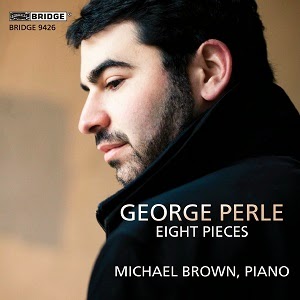
George Perle Portrait in Eight Pieces

George Perle: Eight Pieces 1938-1997)
Michael Brown, piano
Bridge Records


Every composer should have a champion. For George Perle, that champion is pianist Michael Brown. As a teenaged virtuoso, Brown fell in love with Perle's music and had an opportunity to meet the composer. That developed into a close personal and professional relationship over the years, culminating in this release.

Brown collects not only Perle's published works for solo piano, but some earlier works still unperformed at the time of Perle's death. Brown has a deep understanding of Perle's music, and that makes this collection so exciting to listen to. The eight works span Perle's creative output. The earliest work, the 1938 "Classical Suite" receives it's world premier recording here.

In many ways, it's similar to Prokofiev's "Classical Symphony." While using traditional forms and mostly tonal harmonies, Perle continually plays against expectations as his melodies veer off into unexpected directions.

The "Six Celebratory Inventions" (1989-1997) is the collection that Brown played for Perle as a teenager. Each invention honors a different composer by imitating his style. And while one can hear the dedicatee in each movement -- Leonard Bernstein, Gunther Schuller, Ernst Krenek, et al -- it's all filtered through Perle's inventive imagination, giving this set an overarching sense of cohesion.

Michael Brown has lived with some of these works for a while, and he plays with authority and sensitivity. Perle isn't primarily known for his keyboard compositions. Brown's performances suggest they should be reassessed.

Monday, September 15, 2014

Poul Ruders, Vol. 9 - Amiable Chamber Music

Poul Ruders, Vol. 9
David Starobin, guitar; Daniel Druckman, percussion; David Holzman, piano; Amalia Hall, violin; Hsin-Yun Huang, viola, Sara Rothenberg, piano
Bridge Recrods

The two words that sprang to mind as I listened to this collection of Poul Ruder's chamber music was "amiable atonality." These chambers works move well beyond tonality, without a hint of academic dryness. Every work had real personality, often full of warmth and gentle humor.

Guitarist David Starobin and Poul Ruders have enjoyed a long and fruitful collaborative relationship, and Starobin brings his deep understanding of Ruders' music to two works. The "New Rochelle Suite" for guitar and percussion is a witty composition, and Starobin and percussionist Daniel Druckman perform it with a sometimes wink at the audience. Ruders scores imaginatively for percussion, making non-tonal instruments such as the castanets and tom-toms (among many other) add nuanced shading to the guitar's wide-ranging melodies.

"Schrödinger's Cat" is a set of 12 canons for violin and guitar that reflect the ambivalence of the title. In quantum mechanics, Schrödinger's cat is a thought experiment illustrating the paradoxical concept that particles can be in two states simultaneously until observed. So, too, these canons seem to shift back and forth until they suddenly collapse into a final cadence. Starobin and Amalia Hall perform these canons in an unadorned fashion, just presenting the facts -- which seem to change before our ears.

"Romances for viola and piano" is romantic in nature, but the expressive yearnings of the melody get their poignancy from decidedly post-tonal chromatic inflections. Violist Hsin-Yun Huang and pianist Sarah Rothenberg make a great team, though, bring out the emotion in the music without being too emotive.

David Holzman performs "Twinkle Bells - Piano Etude No. 2" with a light, deft touch. He makes the cascading thirds that make up the bulk of the etude shimmer and tinkle like tiny bells. He also brings the album to a close with Ruders' "13 Postludes." These are wonderfully-crafted short little works that evoke the spirit of Chopin -- in an amiably atonal way.

Wednesday, September 10, 2014

Lior Ronser: Awake and Dream

Awake and Dream
Works by Lior Rosner
Janai Brugger; soprano
Katia Popov, violin
The Hollywood Studio Symphony
Steven Vanhauwaert, piano
Lior Rosner, conductor, piano


Lior Rosner is best known for his film and TV scores, which show the wide range of styles he's mastered. This collection of his classical works betrays some of that background -- the music is mostly tonal, and is more about conveying atmosphere and emotion than being concerned about formal structure. And yet these works aren't just fleshed-out film cues. Rather, they're compositions of real substance -- post neo-romantic, if you will.

Rosner's featured soloists are real standouts. Katia Popov performs with a clean, slightly steely tone that's well-suited to these modernist works. Awake and Dream is an impressionistic work that seems to float between dream and reality. Popov spins forth the long, flowing melodies effortlessly, moving from motive to motive seamlessly. The solo violin work "G-Pull" lets Popov display some of her technical skills, but it's her shaping of phrases and subtle articulation that holds the piece together.

Soprano Janai Bugger has a rich, warm voice, with an upper register that sounds well-rounded and clear. She beautifully performs "In time of Silver Rain," a song cycle based on Langston Hughes' poetry. Rosner's settings sound more like Copland and Barber than Duke Ellington, giving these poems a universally American character, rather than African-American. Bugger performs them in a simple, straight-forward fashion, letting the words themselves deliver the emotional impact. By contrast, Bugger provides the emotion for "Three Poems by Sappho." Her singing communicates the full range of emotions this cycle expresses, from ecstatic love to deep mourning.

While the soloists shine, the ensemble could use some polishing. The Hollywood Studio Symphony is a pick-up ensemble, made up of session musicians contracted for the project. There's nothing wrong with that -- but sometimes the ensemble doesn't quite jell. Attacks are a little imprecise and some entrances seem a little tentative. It's not a horrible sound, just a little rough around the edges. I'd be interested in hearing these works performed by an orchestra that has lived together for a while. I expect it would really make the music come alive.

Monday, September 8, 2014

Meyerbeer Overtures and Entr'actes -- Light Entertainment from Grand Opera

Meyerbeer: Overtures and Entr'actes from the French Operas
New Zealand symphony Orchestra
Darrell Ang, conductor
Naxos


When I mentioned I was reviewing this new Meyerbeer recording, I discovered just how low my colleagues held Meyerbeer's music. Robert Schumann didn't care much for it, but I think he -- and others -- miss the point. Giacomo Meyerbeer wasn't out to make pronouncements from God -- he wanted to write entertaining, successful operas. He achieved his goals, and the music in the collection demonstrates why.

Included are instrumental works from Meyerbeer's biggest hits -- "Robert le Diable," "Les  Huguenots," and "L'Africaine" -- along with selections from "Dianorah and Le Prophete. Meyerbeer wrote almost exclusively for the stage, and his works are unfailingly catchy and tuneful.

Darrell Ang conducts the New Zealand Symphony Orchestra with a certain amount of brio, never failing to bring out the drama of the music (without overplaying it). To me, this was a great collection of classical music for casual listening. I just need to be careful who I play it for.

Monday, September 1, 2014

Isserlis Energizes Martinu Cello Sonatas

Martinu: Cello Sonatas 1-3
Works by Sibelius and Mustonen
Steven Isserlis, cello
Olli Mostonen, piano
BIS SACD

Steven Isserlis turns in an attractive program of cello music with this new SACD. Bohuslav Martinu wrote in a very distinctive style; one that was remarkably consistent throughout his long and prolific career. Martinu wrote tonal works, but they were his own version of tonality. Dancing syncopations and shimmering chords are Martinu trademarks, and they're here in abundance.

Playing two or more of Martinu compositions back-to-back -- especially ones using the same forces -- can have the effect of blurring them together. Isserlis avoids this by interspersing works by two composers whose styles complement Martinu's, simultaneously providing contrast and creating a coherent program.

Jean Sibelius' Malinconia, Op. 20 is a dark work, written after the death of the composer's infant daughter. Isserlis convincingly brings out the pathos of the work, while at the same time savoring the beauty of Sibelius' extended melodic lines.

Pianinst Olli Mustonen not only partners with Isserlis in these performances; he also provides a sonata as well. Mustonen's post-romantic composition fits in nicely with the Martinu and Sibelius works, with plenty of rich sonorities and juicy melodic tidbits.

Isserlis doesn't hold back in these performances. Martinu's music has a certain lightness to it, but Isserlis makes it more compelling by really digging into the notes. The urgent character his technique brings to these works makes them, in my opinion, some of the best recorded versions of Martinu's cello sonatas to date. And if you have an opportunity, listen to this release through an SACD player. The intimate nature of this chamber music becomes all the more vivid with the additional sonic details the format provides.