Alessandro Stradella: Cantate Ed Avie
Complesso Barocco Di Milano
Newton
Few composers had as colorful history as Alessandro Stradella. He took part in a scheme to embezzle money from the Catholic Church and had to flee Rome. He was an inveterate womanizer, causing not one but two families to take out a contract on him (as he hastily left town). The first group of assassins failed, the second group succeeded. It's important to remember, though, that during his lifetime Stradella was as famous for his music as he was infamous for his deeds. And this recording helps the listener understand why.
Stradella was a professional opera singer, which informed his writing for the voice. This collection features three of his solo cantatas along with a concert aria and a duet. Stradella's melodies are supple, fluid things that move gracefully with the text.
Il Complesso Barocco Di Milano performs with refreshing directness and clarity. While singers of Stradella's time might have more heavily ornamented his melodies, this ensemble chooses to let the music come through with minimal interference. The sound is a little soft and details are somewhat muted (I suspect this is a vintage analog recording).
One major drawback -- no librettos are included. Stradella's music is so closely intertwined with the text that this is a real minus, as it prevents the listener from fully appreciating Stradella's artistry. And why he was so eagerly sought after by more than just angry husbands.
News and views from the classical music announcers at WTJU, 91.1 FM, Charlottesville, Virginia
Showing posts with label Baroque. Show all posts
Wednesday, June 25, 2014
Monday, March 17, 2014
Florielgium starts strong on Couperin cycle
Couperin/Rebel
Florilegium
Channel Classics SACD
Francois Couperin's 1726 work Les Nations consists of four sections, each one representing a different nationality: France, Spain, Imperial (Germany), and Piedmont (Italy). Each section is massive, consisting of a sonata followed by a suite. Florilegium performs the first two in this new release, with a second volume to follow L'imperiale and La piemontaise.
The ensemble strikes just the right balance in their performances. Couperin's music sounds refined and elegant, but not bloodless. Some of the dance movements are quite spirited (in a tasteful fashion), and melodies flow with easy familiarity that bring these works to life.
Rounding out the recording is Les caracteres de la danse by Couperin's contemporary Jean-Fery Rebel. As played by Florilegium, I can hear a distinct difference between the two composers. Rebel's dance suite sounds more lively and spirited, a little less refined, perhaps than Couperin.
The performances are first-rate, as is the recording. If you have a choice between the SACD and the download, I recommend the former. This is intimate music-making, and the additional detail revealed in the SACD (including the sound of the harpsichord action) just adds to the richness of the listening experience.
Florilegium
Channel Classics SACD
Francois Couperin's 1726 work Les Nations consists of four sections, each one representing a different nationality: France, Spain, Imperial (Germany), and Piedmont (Italy). Each section is massive, consisting of a sonata followed by a suite. Florilegium performs the first two in this new release, with a second volume to follow L'imperiale and La piemontaise.
The ensemble strikes just the right balance in their performances. Couperin's music sounds refined and elegant, but not bloodless. Some of the dance movements are quite spirited (in a tasteful fashion), and melodies flow with easy familiarity that bring these works to life.
Rounding out the recording is Les caracteres de la danse by Couperin's contemporary Jean-Fery Rebel. As played by Florilegium, I can hear a distinct difference between the two composers. Rebel's dance suite sounds more lively and spirited, a little less refined, perhaps than Couperin.
The performances are first-rate, as is the recording. If you have a choice between the SACD and the download, I recommend the former. This is intimate music-making, and the additional detail revealed in the SACD (including the sound of the harpsichord action) just adds to the richness of the listening experience.
Tuesday, January 7, 2014
Telemann Double Concerti a welcome reminder
Georg Philipp Telemann
Double Concerti for Winds & Strings
Rebel ; Jörg-Michael Schwarz conductor
Bridge Records
I always forget about Telemann. Unlike his contemporaries Bach and Handel, he didn't write anything that became a breakout hit, like the "Air on a G String," or "Water Music." But his music was all of a very high quality, full of inventiveness and skill -- as Rebel reminded me with this new recording of Telemann double concerti.
Played with authentic instruments, Rebel presents these works as fresh, robust compositions, brimming with energy. And that makes this a very appealing recording.
The soloists balance nicely between authentic performance practices and individual expression. As a result, these concertos sound like living, breathing works rather than museum pieces.
Recording Rebel in a church was an excellent call. The ambiance is well-suited to the ensemble, vibrant enough to give the music depth, yet intimate enough to hear every detail.
This release is a welcome reminder, indeed.
Double Concerti for Winds & Strings
Rebel ; Jörg-Michael Schwarz conductor
Bridge Records
I always forget about Telemann. Unlike his contemporaries Bach and Handel, he didn't write anything that became a breakout hit, like the "Air on a G String," or "Water Music." But his music was all of a very high quality, full of inventiveness and skill -- as Rebel reminded me with this new recording of Telemann double concerti.
Played with authentic instruments, Rebel presents these works as fresh, robust compositions, brimming with energy. And that makes this a very appealing recording.
The soloists balance nicely between authentic performance practices and individual expression. As a result, these concertos sound like living, breathing works rather than museum pieces.
Recording Rebel in a church was an excellent call. The ambiance is well-suited to the ensemble, vibrant enough to give the music depth, yet intimate enough to hear every detail.
This release is a welcome reminder, indeed.
Friday, May 3, 2013
Steffani Cantatas -- Handel's inspiration?
Steffani: Cantate Da Camera
Quadro Asolano
Newton
Agostino Steffani (1650-1723) was a master of Baroque vocal chamber music. This Italian composer spent most of his professional career in Germany, first in Munich then at the court of Hanover. He composed exclusively for the voice; sacred works, secular cantatas and operas. This recording features two of the solo cantatas and four of the vocal dues he wrote.
Steffani's lyrical counterpoint was closely studied by a young Georg Frederick Handel. And that influence is easy to hear in these examples. Steffani's melodies have the same, straight-forward simplicity of Handel's. And the polyphonic passages are also a model of clarity. There's nothing fussy about Steffani's counterpoint, rather, it's all elegantly constructed.
Based on the quality of Steffani's music, it's surprising he isn't more frequently performed or recorded. So Newton's release does a real service with these world premier recordings. The performances by the Quadro Asolano are generally good, although sometimes the soprano voices are a little weak.
My only complaint is that Newton's program notes don't provide the libretti for the works. Steffani's music often illustrates or takes its character from the text its supporting. Without the libretti (or a fluency in Italian), Steffani's subtle gestures are lost on the listener.
Quadro Asolano
Newton
Agostino Steffani (1650-1723) was a master of Baroque vocal chamber music. This Italian composer spent most of his professional career in Germany, first in Munich then at the court of Hanover. He composed exclusively for the voice; sacred works, secular cantatas and operas. This recording features two of the solo cantatas and four of the vocal dues he wrote.
Steffani's lyrical counterpoint was closely studied by a young Georg Frederick Handel. And that influence is easy to hear in these examples. Steffani's melodies have the same, straight-forward simplicity of Handel's. And the polyphonic passages are also a model of clarity. There's nothing fussy about Steffani's counterpoint, rather, it's all elegantly constructed.
Based on the quality of Steffani's music, it's surprising he isn't more frequently performed or recorded. So Newton's release does a real service with these world premier recordings. The performances by the Quadro Asolano are generally good, although sometimes the soprano voices are a little weak.
My only complaint is that Newton's program notes don't provide the libretti for the works. Steffani's music often illustrates or takes its character from the text its supporting. Without the libretti (or a fluency in Italian), Steffani's subtle gestures are lost on the listener.
Wednesday, December 12, 2012
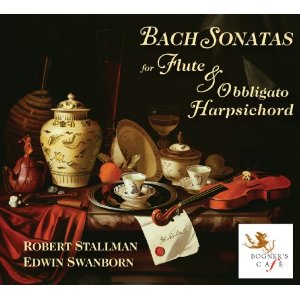
Bach's Evenings at Zimmerman's Coffeehouse
Evenings at Zimmermann's Coffeehouse
Robert Stallman, flute, Edwin Swanborn, harpsichord
Bogner's Cafe
The subtitle of this release aptly describes the disc. In 1730's J.S. Bach spend a significant amount of time at Zimmermann's Coffeehouse in Leipzig. It was one of the regular performing venues for the Collegium Musicum, which he directed (and wrote music for). Most of his instrumental music of this period were written for this group, including the four flute sonatas in this release. By no means are these major works. Of course, it is Bach, so the sonatas are well-crafted, but the music is intentionally light and simple. This is more the Bach of "Air on G String" than the Bach of the Cello Sonatas.
Robert Stallman performs on a modern flute, but that just gives the works additional charm. The music mostly stays in the lower part of the flute's register, and Stallman produces a very warm sound on his instrument. The result is some attractive playing and a pleasant listening experience overall. Edwin Swanborn provides tasteful accompaniment on the harpsichord. The keyboard obbligato helps move the music along without sounding overly busy or fussy. An attractive program of music played with just the right tone to keep the proceedings light and entertaining -- as perhaps they were in Zimmermann's over three centuries before.
Friday, June 15, 2012
"Fathers and Sons of the Bach Family"
Father’s Day is this Sunday, 17 June. To mark the occasion, on Classical Sunrise that morning (6 to 9 AM), I’ll be doing a show titled “Fathers and Sons of the Bach Family.”
Of course you can expect to hear music of Johann Sebastian Bach and his sons, but I will also be featuring works from other lesser-known members of this extraordinary family. The Bach line of professional musicians spans over six generations.
According to the family chronicles, Veit Bach, a baker by trade (d. ca. 1576), was the forefather of this dynasty and the first to show musical proclivities. His son Hans (d. 1626) was the first known professional musician, and his three sons in turn established different branches of the Bach family of musicians.
Among other samplings, we’ll hear music of Heinrich Bach (1615-1692), son of Hans and founder of the Arnstadt line, and that of his son Johann Michael Bach (1648-1694). We’ll explore the music of Johann Bach (1604-1673), also the son of Hans, and the founder of the Erfurt line of the family, and listen to music of Johann’s great grandson, Johann Ernst Bach (1722-1777).
In my mind, no day is complete without the music of JS Bach, and with 20 children to his name (10 of which survived to adulthood), JS Bach is perhaps the musical epitome of Fathers and Sons.
So tune in to Classical Sunrise this Sunday, 17 June 2012, on WTJU Charlottesville, 91.1 FM, and streaming live on www.wtju.net, to celebrate the music of the most important family in the history of Western music.
And if you missed the program, you can hear it again on-demand anytime over the next two weeks at our Virtual Tape Vault.
Of course you can expect to hear music of Johann Sebastian Bach and his sons, but I will also be featuring works from other lesser-known members of this extraordinary family. The Bach line of professional musicians spans over six generations.
According to the family chronicles, Veit Bach, a baker by trade (d. ca. 1576), was the forefather of this dynasty and the first to show musical proclivities. His son Hans (d. 1626) was the first known professional musician, and his three sons in turn established different branches of the Bach family of musicians.
Among other samplings, we’ll hear music of Heinrich Bach (1615-1692), son of Hans and founder of the Arnstadt line, and that of his son Johann Michael Bach (1648-1694). We’ll explore the music of Johann Bach (1604-1673), also the son of Hans, and the founder of the Erfurt line of the family, and listen to music of Johann’s great grandson, Johann Ernst Bach (1722-1777).
In my mind, no day is complete without the music of JS Bach, and with 20 children to his name (10 of which survived to adulthood), JS Bach is perhaps the musical epitome of Fathers and Sons.
So tune in to Classical Sunrise this Sunday, 17 June 2012, on WTJU Charlottesville, 91.1 FM, and streaming live on www.wtju.net, to celebrate the music of the most important family in the history of Western music.
And if you missed the program, you can hear it again on-demand anytime over the next two weeks at our Virtual Tape Vault.
Saturday, March 10, 2012
Happy 327th Birthday, Johann Sebastian Bach (21 March 2012) (1685-1750)
![]() |
| Bach's final unfinished fugue. |
Bach was the undisputed master of fugal writing, and the Art of Fugue is the culmination of his skill and artistry. The work consists of 14 fugues and four canons. The inventiveness and genius of the piece is breathtaking. It was his last major composition; Bach died before he could complete it. The abrupt ending in the middle of the last fugue, and the profound silence thereafter, speaks to my soul in a way that no other single piece of music can match.
Bach’s Mass in B Minor, BWV 232, is in some ways the vocal equivalent of the Art of Fugue: the Mass was his last choral composition, representing the crowning achievement in this genre. He completed it in 1749, the year before he died, although parts of it were composed decades earlier.
Bach’s setting of the Passion According to St. Matthew, BWV 244, was composed for Good Friday 1727 in Leipzig. Every year at St. Thomas Church in Leipzig, a Passion traditionally was performed on Good Friday. It was the high point in the church calendar, particularly coming as it did after Lent during which no music was performed in the church. Bach, as a cantor at St. Thomas church, had earlier composed the St. John Passion, BWV 245, but it lacked the unity that Bach achieved in the St. Matthew Passion. Only these two Passions survive of the five passions that were mentioned in his obituary. The St. Matthew Passion, known as the “Great Passion,” in Bach’s family, according to Christoph Wolff, surpassed all that Bach had previously composed in sacred music.
Bach’s compositions were all intended for the glory of God. Perhaps nowhere is Bach’s intention more evident than in these three grand-scale pieces.
Thursday, February 23, 2012
A New Recording of The Eight Great Keyboard Suites of Georg Frederich Handel
Handel: Eight Great Keyboard Suites
Lisa Smirnova, piano
ECM
As far as I am concerned, the never-ending debate on the appropriateness of playing Baroque keyboard music on harpsichord or piano falls on deaf ears. The embellishment that the modern piano brings to Baroque music adds greatly to its enjoyment.
Throughout the years, a host of pianists such as Glenn Gould, Andras Schiff, Angela Hewitt, and Murray Perahia among others has contributed a rich collection of keyboard transcriptions of Bach, Handel, Scarlatti, and many other Baroque masters.
The eight keyboard suites (HWV 426-433) of Georg Frederich Handel have often been recorded on piano, but perhaps never better than on a new ECM recording by Russian-born pianist Lisa Smirnova. Smirnova, a longtime resident of Vienna, spent several years studying the suites before recording them this year.
Handel published the suites in 1720, because “Surrepticious and incorrect Copies of them had got Abroad.” Their beauty and energy have delighted audiences ever since. As Smirnova notes in the accompanying CD literature, Handel made full use of Italian, German, and French influences that he absorbed so flawlessly. And as with any of Handel’s instrumental music, the listener is rewarded with oratorical whispers just beneath the surface.
I would like to believe that the Russian heritage of Lisa Smirnova is partly responsible for both the technical brilliance of her playing but also her passion and energy. Much as Angela Hewitt has done recently with Bach’s Well-Tempered Clavier, Smirnova offers a complete body of work that is impossible to resist. I can predict that the keyboard suites of GF Handel played by Lisa Smirnova will soon be heard on WTJU.
- John Delehanty, host of "Dawn's Early Light," heard Mondays 6-9am on WTJU.
Lisa Smirnova, piano
ECM
As far as I am concerned, the never-ending debate on the appropriateness of playing Baroque keyboard music on harpsichord or piano falls on deaf ears. The embellishment that the modern piano brings to Baroque music adds greatly to its enjoyment.
Throughout the years, a host of pianists such as Glenn Gould, Andras Schiff, Angela Hewitt, and Murray Perahia among others has contributed a rich collection of keyboard transcriptions of Bach, Handel, Scarlatti, and many other Baroque masters.
The eight keyboard suites (HWV 426-433) of Georg Frederich Handel have often been recorded on piano, but perhaps never better than on a new ECM recording by Russian-born pianist Lisa Smirnova. Smirnova, a longtime resident of Vienna, spent several years studying the suites before recording them this year.
Handel published the suites in 1720, because “Surrepticious and incorrect Copies of them had got Abroad.” Their beauty and energy have delighted audiences ever since. As Smirnova notes in the accompanying CD literature, Handel made full use of Italian, German, and French influences that he absorbed so flawlessly. And as with any of Handel’s instrumental music, the listener is rewarded with oratorical whispers just beneath the surface.
I would like to believe that the Russian heritage of Lisa Smirnova is partly responsible for both the technical brilliance of her playing but also her passion and energy. Much as Angela Hewitt has done recently with Bach’s Well-Tempered Clavier, Smirnova offers a complete body of work that is impossible to resist. I can predict that the keyboard suites of GF Handel played by Lisa Smirnova will soon be heard on WTJU.
- John Delehanty, host of "Dawn's Early Light," heard Mondays 6-9am on WTJU.
Wednesday, February 1, 2012
Johannes Eccard: Sacred and Secular Works
Johannes Eccard: Sacred & Secular Works
Opella Musica
Ensemble NOEMA
Gregor Meyer, director
CPO
Although not a household name, Johannes Eccard can hardly be called an obscure composer. Active during the latter half of the 16th century, Eccard's vocal music was held in high regard by other composers -- especially German composers, from Johann Sebastian Bach through Brahms. In his own lifetime, he was seen as the Protestant answer to Palestrina (and his music was considered just as good).
This new collection of Eccard's sacred and secular works justifies that assessment. Eccard studied with Orlando de Lassus. The secular works show Lassus' influence. Eccard sets his texts in a similar style, letting the nature of the words dictate the shape of the melody whenever possible. And his polyphonic sacred works show the same facility for counterpoint as Lassus. The lines flow naturally, weaving in and out of each other creating marvelous patterns that sound neither academic nor contrived.
Also included are some of Eccard's works for the fledgling Protestant movement. His settings of the simple congregational hymn tunes show great imagination, while remaining true to the melody. Eccard's original hymns have simple, straight-forward patterns, but are written with rich harmonic possibilities for Eccard (and later on other composers) to explore.
Cudos to Gregor Meyer and his ensembles for presenting this music. Their performances are clean and unaffected, letting the structure of the music come through clearly. Listening to this recording, it's easy to understand why Bach closely studied Eccard's music.
Opella Musica
Ensemble NOEMA
Gregor Meyer, director
CPO
Although not a household name, Johannes Eccard can hardly be called an obscure composer. Active during the latter half of the 16th century, Eccard's vocal music was held in high regard by other composers -- especially German composers, from Johann Sebastian Bach through Brahms. In his own lifetime, he was seen as the Protestant answer to Palestrina (and his music was considered just as good).
This new collection of Eccard's sacred and secular works justifies that assessment. Eccard studied with Orlando de Lassus. The secular works show Lassus' influence. Eccard sets his texts in a similar style, letting the nature of the words dictate the shape of the melody whenever possible. And his polyphonic sacred works show the same facility for counterpoint as Lassus. The lines flow naturally, weaving in and out of each other creating marvelous patterns that sound neither academic nor contrived.
Also included are some of Eccard's works for the fledgling Protestant movement. His settings of the simple congregational hymn tunes show great imagination, while remaining true to the melody. Eccard's original hymns have simple, straight-forward patterns, but are written with rich harmonic possibilities for Eccard (and later on other composers) to explore.
Cudos to Gregor Meyer and his ensembles for presenting this music. Their performances are clean and unaffected, letting the structure of the music come through clearly. Listening to this recording, it's easy to understand why Bach closely studied Eccard's music.
Wednesday, January 4, 2012
Vivaldi: Return of Angels
Vivaldi: Return of the Angels
Ensemble Caprice
Matthias Maute, conductor
Analekta
“The Return of Angels” is billed as a collection of Vivaldi’s sacred music arranged in an attractive program. The Ensemble Caprice under Matthias Maute perform these works with a lightness and transparency that make for an enjoyable listening experience.
The disc starts with Juditha triumphans, one of Vivaldi’s four surviving oratorios. Originally, this music was performed by girls of the orphanage where he directed the music program. Ensemble Caprice also uses an exclusively female cast, giving the drama a serene, otherworldly feel. By cutting out the long stretches of secco recitative, the Ensemble pares this large work down to a compact and appealing suite.
The motet O qui coeli terraeque serenitas (RV 631) is a study in contrasts, both in vocal style and orchestral writing. Soprano Gabriele Hierdeis floats effortlessly above the busy ensemble, turning in an appealing performance.
In addition to some psalms and the Et in terra pax from the “Gloria” (RV 588), there are also some excerpts from the oratorio Gesu al cavario by Vivaldi’s colleague in Dresden, Jan Dismas Zelenka. Zelenka’s music compares favorably to Vivaldi’s – without looking at the program notes, the casual listener might not hear the difference.
Also included is a Vivaldi concerto for two recorders (RV 566) and another for Trumpet and Oboe (RV563). Both works are ably played by the Ensemble Caprice, and provide a nice contrast to the vocal selections.
Ensemble Caprice
Matthias Maute, conductor
Analekta
“The Return of Angels” is billed as a collection of Vivaldi’s sacred music arranged in an attractive program. The Ensemble Caprice under Matthias Maute perform these works with a lightness and transparency that make for an enjoyable listening experience.
The disc starts with Juditha triumphans, one of Vivaldi’s four surviving oratorios. Originally, this music was performed by girls of the orphanage where he directed the music program. Ensemble Caprice also uses an exclusively female cast, giving the drama a serene, otherworldly feel. By cutting out the long stretches of secco recitative, the Ensemble pares this large work down to a compact and appealing suite.
The motet O qui coeli terraeque serenitas (RV 631) is a study in contrasts, both in vocal style and orchestral writing. Soprano Gabriele Hierdeis floats effortlessly above the busy ensemble, turning in an appealing performance.
In addition to some psalms and the Et in terra pax from the “Gloria” (RV 588), there are also some excerpts from the oratorio Gesu al cavario by Vivaldi’s colleague in Dresden, Jan Dismas Zelenka. Zelenka’s music compares favorably to Vivaldi’s – without looking at the program notes, the casual listener might not hear the difference.
Also included is a Vivaldi concerto for two recorders (RV 566) and another for Trumpet and Oboe (RV563). Both works are ably played by the Ensemble Caprice, and provide a nice contrast to the vocal selections.
Wednesday, August 17, 2011
Review: Farinelli the composer
Farinelli: The Composer
Jorg Washchinski, male soprano
Salburger Hofmusik; Wolfgang Brunner, conductor
New Classical Adventure
“Farinelli the composer” is a fascinating release. Carlo Broschi (AKA Farinelli) was – by all accounts – the greatest castrato opera singer of his day, and perhaps of all time. But because Farinelli conquered the stage 200 hears before sound recording technology, we only have contemporary descriptions of his voice to judge the extent of his talent.
Fortunately, in addition to being a singer, Farinelli was also a composer. Like many virtuosos of his day, he wrote music exclusively for his own performances -- primarily arias. Baroque opera singers were expected to improvise around the written score, and Farinelli was no exception. Of course, such improvisations are ephemeral. But just as a Miles Davis composition can provide insight into his improvisational style, so too does Farinelli’s arias give us a better idea of what his voice was capable of, and how he was likely to improvise in performance.
The arias on this release are of great historical interest, which is not to say they’re without compositional merit. Even though the orchestrations are run-of-the-mill, Farinelli was a better than average composer with a real gift for melody (not surprisingly). The vocal lines he wrote for himself are full of unusual twists, turns, and leaps that could trip up a lesser singer.
Sopranist Jorg Waschinski is more than equal to the task, and does an outstanding job with this material. No matter how talented the countertenor, the range is always a little more constrained than that of a true castrato. Nevertheless, Waschinski soars through the upper register seemingly without effort, delivering a clear, full-voiced sound.
If you’ve seen the movie “Farinelli” then you know of the man’s reputation. But the voice you heard was a digital blend of different singers. In this release you hear an actual singer delivering Farinelli’s music to the best of his formidable ability. And the humanity of Waschinski's voice makes all the difference.
Although we can never really know what Farinelli sounded like, this recording of his music brings us a little bit closer.
Highly recommended for anyone interested in Baroque or Classical era opera.
Jorg Washchinski, male soprano
Salburger Hofmusik; Wolfgang Brunner, conductor
New Classical Adventure
“Farinelli the composer” is a fascinating release. Carlo Broschi (AKA Farinelli) was – by all accounts – the greatest castrato opera singer of his day, and perhaps of all time. But because Farinelli conquered the stage 200 hears before sound recording technology, we only have contemporary descriptions of his voice to judge the extent of his talent.
Fortunately, in addition to being a singer, Farinelli was also a composer. Like many virtuosos of his day, he wrote music exclusively for his own performances -- primarily arias. Baroque opera singers were expected to improvise around the written score, and Farinelli was no exception. Of course, such improvisations are ephemeral. But just as a Miles Davis composition can provide insight into his improvisational style, so too does Farinelli’s arias give us a better idea of what his voice was capable of, and how he was likely to improvise in performance.
The arias on this release are of great historical interest, which is not to say they’re without compositional merit. Even though the orchestrations are run-of-the-mill, Farinelli was a better than average composer with a real gift for melody (not surprisingly). The vocal lines he wrote for himself are full of unusual twists, turns, and leaps that could trip up a lesser singer.
Sopranist Jorg Waschinski is more than equal to the task, and does an outstanding job with this material. No matter how talented the countertenor, the range is always a little more constrained than that of a true castrato. Nevertheless, Waschinski soars through the upper register seemingly without effort, delivering a clear, full-voiced sound.
If you’ve seen the movie “Farinelli” then you know of the man’s reputation. But the voice you heard was a digital blend of different singers. In this release you hear an actual singer delivering Farinelli’s music to the best of his formidable ability. And the humanity of Waschinski's voice makes all the difference.
Although we can never really know what Farinelli sounded like, this recording of his music brings us a little bit closer.
Highly recommended for anyone interested in Baroque or Classical era opera.
Subscribe to:
Posts (Atom)