Showing posts with label concerto. Show all posts

Tuesday, February 25, 2014

Alexander Fiterstein dances through Weber clarinet concertos

Carl Maria von Weber
Clarinet Concertos Nos. 1 & 2
Concertino for Clarinet, Op. 26

Alexander Fiterstein, clarinet
San Francisco Ballet Orchestra
Martin West, conductor
Bridge Records

Mozart was the first major composer to compose a clarinet concerto, but Weber runs a close second. Written a generation after Mozart, Weber's two clarinet conceri hold a similar place in the repertoire.

Clarinetist Alexander Fiterstein brings out those similarities in this new recordings. His liquid tone and precise intonation bring a classical elegance to these works -- a touch Mozart might appreciate.

Yet Fiterstein nimbly leaps about, almost dancing with the music. Perhaps its appropriate then, that he should be accompanied by a ballet orchestra, then. The San Francisco Ballet Orchestra, directed by Martin West provide a light and transparent ensemble sound that further strengthen the similarities between Mozart and Weber.

That's not to say these are pretty performances. Fiterstein and company provide plenty of drama and weight when required to -- especially in the second concerto. On the whole, appealing and inviting performances of these familiar works.

Friday, January 17, 2014

Evelyn Glennie conjures up a great performance with Corgliano concerto

John Corigliano
Conjurer for percussion soloist and string orchestra
Vocalise for soprano and orchestra
Evelyn Glennie, percussion; Hila Plitmann, soprano
Albany Symphony Orchestra
David Allen Miller, conductor
Naxos

This new recording brings together two unusual additions to John Corigliano's repertoire. "Conjurer" is a percussion concerto composed for Evelyn Glennie (who performs on this release). The work has six sections: three cadenzas, and three movements, labeled Wood, Metal, and Skin. Each movement uses percussion instruments only belonging to its own group.

Corigliano blends tonal and non-tonal percussion instruments with alacrity. Each cadenza leads into a movement where the string orchestra further develops the themes, along with the soloist. It's an effective work when done well -- and in this recording, it's done very well.

"Vocalise" is the older of the two works, being completed in 1999. This challenging work for soprano, electronics and orchestra plays against audience expectations. When the piece begins, it sounds like a typical contemporary work. The melody seems to skip all over the place, the electronics add a strangeness and artificiality to the sound, and the orchestra bloops and bleeps away with tone clusters and glissandi.

But very soon things start to change. Like a flower blossoming, the work opens up. The melody becomes more tonal, the electronics more subtle, and the ensemble more expansive. It ends quietly, having made the journey through the full potential of the human voice.

The Albany symphony performs admirably in both works. Soprano Hila Plitmann has a pure sustained tone that gives her performance an ethereal quality -- one in keeping with the intent of "Vocalise."

Recommended.

Tuesday, January 7, 2014

Telemann Double Concerti a welcome reminder

Georg Philipp Telemann
Double Concerti for Winds & Strings
Rebel ; Jörg-Michael Schwarz conductor
Bridge Records


I always forget about Telemann. Unlike his contemporaries Bach and Handel, he didn't write anything that became a breakout hit, like the "Air on a G String," or "Water Music." But his music was all of a very high quality, full of inventiveness and skill -- as Rebel reminded me with this new recording of Telemann double concerti.

Played with authentic instruments, Rebel presents these works as fresh, robust compositions, brimming with energy. And that makes this a very appealing recording.

The soloists balance nicely between authentic performance practices and individual expression. As a result, these concertos sound like living, breathing works rather than museum pieces.

Recording Rebel in a church was an excellent call. The ambiance is well-suited to the ensemble, vibrant enough to give the music depth, yet intimate enough to hear every detail.

This release is a welcome reminder, indeed.

Monday, January 6, 2014

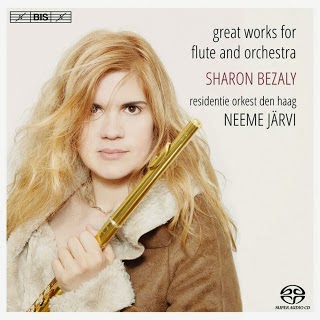
Sharon Bezaly - Great Works for Flute and Orchestra

Great Works for Flute and Orchestra
Sharon Bezaly, flute
Residentie Orkest Den Haag
Neeme Jarvi, conductor
SACD
BIS


Sharon Bezaly has been steadily gaining attention in the classical world, and this recording simply adds to her reputation.

Bezaly plays with a very clear, pure tone that's well-suited to the material in this collection. Her command of the flute is exemplary. She maintains control in the extremes of the upper register, keeping the sound warm and rounded, never edgy or shrill. Her agility and precision make difficult passages seem easy -- and makes them easy to follow.

The "Great Works for Flute and Orchestra" are a mixture of pieces originally written for that configuration, and some interesting arrangements.Original works include concertos by Carl Nielsen and Carl Reinecke, a concertino by Cecile Chaminade, and the Poem for flute and orchestra by Charles Tomlinson Griffes. Arrangements include Tchaikovsky's largo and allegro, and the perennial encore piece, "Flight of the Bumblebee." Lennox Berkeley's orchestration of Francis Poulenc's Flute Sonata retains character of the work, fleshing out the structure in an interesting fashion.

The Nielsen concerto is the most aggressive of the works in the program, and one Bezaly plunges into with great relish. By contrast, she performs the Chaminade concertino with a charming tenderness entirely appropriate to the work.

Neeme Jarvi draws a warm, sympathetic sound from the  Resident Orchestra of the Haag, and BIS (as always) delivers a natural-sounding recording. Although available for download, I recommend the SACD version if you have the playback equipment. The subtleties of Bezaly's phrasing (and remarkable breath control) can only be fully appreciated in this higher fidelity format.

Tuesday, November 19, 2013

Wendy Warner: Haydn & Myslivecek - An appealing program

Haydn; Myslivecek: Cello Concertos
Wendy Warner, cello
Camerata Chicago; Drostan Hall, conductor
Cedille

An appealing program played by a masterful virtuoso. That's my impression of this new release from Cedille. As with many recordings, this Chicago-based label uses local talent -- but what talent it is!

Drostan Hall and the Camerata Chicago perform with precision and sensitivity admirably suited to Haydn. And Wendy Warner, though from Chicago, is an internationally-recognized cellist who brings a fresh interpretation to some well-known works.

The two cello concertos of Franz Joseph Haydn have long been repertoire staples, and just about every major cellist has recorded them. Warner's performances are expressive without being overly dramatic. The clear, singing tone of her Guarneri cello is beautiful -- and beautifully recorded. And Warner's interpretation, accompanied by a small ensemble, makes these works sound warmly intimate.

Sandwiched between the Haydn concertos on the album is Josef Myslivecek's only concerto for cello. A contemporary of Haydn (and friend of Mozart), Myslivecek's wrote in a similar style that nicely complements the Haydn concerti. And the Myslivecek concerto does not suffer for the comparison. Myslivecek wrote in a leaner, more straight-forward manner, bringing the aesthetics of the classical style to the forefront of his music.

Tuesday, November 5, 2013

Peter Maxwell Davies: Strathclyde Concertos Nos. 3 & 4

Maxwell Davies: Strathclyde Concertos Nos. 3 and 4
Robert Cook, French horn
Peter Franks, trumpet
Lewis Morrison, clarinet
Scottish Chamber Orchestra
Peter Maxwell Davies, conductor
Naxos

The Strathclyde Concertos are a unique group of compositions. Commissioned by Strathclyde, Peter Maxwell Davies composed one concerto a year for the Scottish Chamber Orchestra. The ten concertos, spanning a decade, make an impressive -- and somewhat unified -- body of work.

This release features the third concerto for horn and trumpet, and the fourth concerto for clarinet in arguably the most authoritative performances recorded -- the Scottish Chamber Orchestra for whom the works were written, conducted by the composer himself.

One of the characteristics of the Strathclyde concertos is the elimination of competing voices from the orchestra, throwing the solo instruments in sharp relief to the ensemble. So the third concerto has no brass instruments, save for the solo French horn and trumpet. The fourth concerto has only one clarinet -- the soloist.

Each concerto fully explores the possibilities of the solo instruments, and those possibilities influence the direction of the work. The brass concerto is more aggressive than the clarinet concerto, with wider melodic leaps and an higher energy level overall. The clarinet concerto, while more lyrical and soft-spoken, is not without some spiky sections as well.

This is a re-release from the Collins Classic series (they recorded Concertos 3-10). I'm hoping Naxos will eventually reissue the rest, and perhaps the first two from Unicorn-Kanchana too, please?

Wednesday, July 10, 2013

Holmboe: Concertos -- Unabashed neo-classical richness

Holmboe: Concertos
Norrkoping Symphony Orchestra
Dima Sloboderiouk, conductor
Erik Heide, violin
Lars Anders Tomter, viola
DaCapo SACD

Danish composer Vagn Holmboe (1909-1996)  remained true to himself, throughout his career, writing the music he wanted to with little regard for academic fashion. While generally neo-classical in style, his music has a distinctive individuality to it -- as this collection proves. These three concerti span a half-century, yet they collectively form a homogeneous program.

Holmboe's Concerto for Viola is a two movement work written in 1992. Holmboe relishes the rich warmth of the viola's lower register. Sprightly and spiky passages alternate with bursts of long, lyrical melodies. Lars Tomter's expressive playing adds tremendously to the emotional content of this work.

Holmboe takes a different tack with his 1929 Concerto for Orchestra than Bartok does. Unlike Bartok, Holmboe doesn't isolate the various sections of the orchestra. This is big, heroic music that revels in the blended sound of the ensemble. While there are some quiet sections that use just parts of the orchestra, they're not showcased. Rather, the focus remains on the virtuosity of the collective whole.

The Violin Concerto No. 2 (1979) is more aggressively modern than the other works on this release. It's not quite atonal. Rather, it's highly chromatic music with the violin leaping and skipping about in the opening and closing sections. But the heart of the work is in the slow sections, where Holmboe lets the violin sing -- and Erik Heide does indeed make his instrument do so.

While this release is available as a download, I highly recommend the SACD version -- especially if you have an SACD player. These performances were lovingly recorded by DaCapo, and the fullness of the sound adds an extra dimension to these appealing works.

Monday, June 10, 2013

Arabella Steinbacher: Bruch/Korngold Violin Concertos

Bruch/Korngold Violin Concertos
Arabella Steinbacher, violin
Gulbenkian Orchestra, Lisbon
Lawrence Foster, conductor
Pentatone

Arabella Steinbacher brings together three well-known works that all look to the Romantic Period; the Bruch Violin Concerto No. 1, Chausson's Poeme, and Eric Korngold's Violin Concerto.

Max Bruch was a staunch defender of the traditional romanticism of Mendelssohn and Brahms, an aesthetic reflected in his most popular work, the Violin Concerto No. 1 in G minor. Ernest Chausson (1855-1899) wrote his Poeme for Violin and Orchestra during the end of the Romantic period, and while somewhat forward-looking, still has its roots in the 19th Century. Eric Korngold finished his Violin Concerto in 1945, writing in the unabashedly late-Romantic style of his youth.

Because all three of these works were written for with a Romantic aesthetic, one might expect a release full of over-wrought drama and passion. Steinbacher takes a different approach.

Rather than focus on the emotive qualities of the music. Steinbacher plays with a clean, clear tone and temperament well-suited to these works. Her performances are thoughtful, eschewing overblown emotional and technical fireworks. Rather, Steinbacher colors the music more subtly. A light tripping over the strings sounds like a smile. A long, drawn out melody can seem wistful, a technically difficult passage played with ease and a little bit of self-effacement. Steinbacher's art is quietly attractive, and one that can make even these overly-familiar works sound fresh.

Of course one can play this release on a standard CD player, but to really appreciate everything that's going on here, I recommend using an SACD player. The more detailed SACD recording reveals all the nuances of Steinbacher's playing. And it also presents the Gulbenkain Orchestra more accurately. Conductor Lawrence Foster matches Steinbacher's approach to these works, and additional presence the SACD provides makes for a more satisfying listening experience overall.

Sunday, May 19, 2013

"Through the Reeds" is thoroughly enjoyable

Walter Ross: Through the Reeds
Woodwind Concerti
Slovak Radio Symphony Orchestra
Kirk Trevor, conductor
Ravello Records


On Walter Ross' website, it says "he likes to write music that musicians enjoy performing and audiences enjoy hearing." That claim is ably supported by the works on this new release from Ravello.

Ross' primary instrument was the french horn, an instrument common to both brass and wind quintets. The concertos on this release might not push the technical boundaries of the solo instruments, but each one plays music that is uniquely suited to it.

The oboe d'amore is a somewhat obscure instrument, falling into disuse after the Baroque period and revived in the 20th Century. Ross' concerto is a welcome addition to the repertoire. His modal harmonies give the worka neo-renaissance flavor, through which the oboe d'amore hops and skips and sings. Michal Sintal is an able soloist, and Ross' music shows off the capabilities of his instrument to best advantage.

The Concerto for Bassoon and String Orchestra has an almost Coplanesque feel to it in places. Humor and good spirits are common elements in Ross' music, and this jovial concerto  fits right in. The middle movement is especially beautiful, and soloist Ramon Masina makes the most of the lyrical nature of the music.

The Concerto for Flute and Guitar is light and airy, perfectly suited to these two instruments. The middle movement has a Latin flavor to it, but only just -- this is Ross, not Rodrigo.

The final work on the album, the Concerto for Oboe, Harp and String orchestra rounds out the program nicely. Ross' straight-forward style is consistent throughout the album. The strings chug along in seemingly simple yet ever-changing patterns. The oboe and the harp dance around each other in a jovial fashion. Underneath this attractive surface Ross has constructed a solid work woven together by motivic development.

To paraphrase the composer, these were concerti that musicians enjoyed performing, and I enjoyed hearing.

Wednesday, April 4, 2012

Shelley makes the case for Kalkbrenner

Romantic Piano Concerto Vol. 56: Kalkbrenner 
Piano Concerto No 2, Op. 85 
Piano Concerto No.3, Op. 107 
Adagio & Allegro di Bravura, Op. 102 
Howard Shelly, piano 
Tasmanian Symphony Orchestra 
Hyperion

I’m a big fan of Hyperion’s Romantic Piano Concerto series. This latest installment – Volume 56 – maintains the same high standards of recording and performance quality as the previous volumes.

Howard Shelley turns in committed performances of Friedrich Kalkbrenner's compositions. Shelley's interpretations seem to fully realize the potential of this neglected music.

 And this is music that needs a little help.

Audiences of the mid-19th century thought Friedrich Kalkbrenner one of the best pianists of his day – an opinion he shared himself. When Chopin arrived in Paris, he performed for Kalkbrenner. – who suggested that after three years of study with him, Chopin just might make a decent pianist! That inflated opinion of himself was the subject of satire during his lifetime, and part of the reason why his music fell into disrepute after his death. It's good to have it represented (especially by a sympathetic performer), so we can judge the merits of Kalkbrenner's music for ourselves.

Kalkbrenner, like many virtuosos of the day, composed music primarily for his own use. The works on this recording were all written for various concert tours, and so were created to do two things: appeal to audiences with their tunefulness, and impress audiences with their brilliant piano technique. They achieve both goals admirably.

The two concertos on this CD are written in a glittering, gallante style, The musical language is a little conservative – think Mendelssohn rather than Liszt – which keeps them from being truly great compositions. While there are plenty of grand gestures and crashing climaxes Kalkbrenner’s romanticism has a certain polite reserve.

This is music that’s meant to entertain. And on that level, it succeeds. Kalkbrenner may have thought highly of his talent, but if the piano solos in these works are any indication of what he could do, it’s an opinion not without merit. Shelley’s hands cascade down with complex arpeggiated patterns. They undulate up and down the keyboard, riding waves of scale patterns that are both pretty and pretty impressive.

Shelley performed the first and last of Kalkbrenner’s four piano concertos in volume 41 of the series (Kalkbrenner: Piano Concertos Nos. 1 & 4). With this installment, he fills out the cycle with the two middle concertos. Kalkbrenner’s music may be somewhat simple (in structure, if not in execution), but that’s part of its appeal. I, for one, thoroughly enjoyed it.

Wednesday, March 21, 2012

Rautavaara: New Concertos from a Finnish Master

Rautavaara: Towards the Horizon; Modificata; Incantations 
Truls Mork, cello
Colin Currie, percussion
Helsinki Philharmonic Orchestra; John Storgards, conductor
Ondine

This new release sheds some light onto Einojuhani Rautavaara's growth as a composer. The outer two works are  recent concertos, composed in 2008/2009. But the middle work, Modificata, was written in 1957, when Rautavaara  was just 29 years old  and very much enamored with serial composition.

The current version, though, is his 2003 revision of the work, which smoothed out some of the jagged edges. Still, it's a very stark and aggressive-sounding work, especially when compared to the concertos that flank it.

Rautavaara's second cello concerto, "Towards the Horizon" is a single-movement work full of expression. The cello seems to float along over top of an orchestral ocean of ethereal harmonies.  As the title suggests, there's a sense of motion towards a destination that's always out of reach. And while the cello part isn't that challenging technically, to meaningfully convey all the emotion written into the score requires top-notch musicianship. And Truls Mork fills that role admirably.

"Incantations" is a percussion concerto composed for Colin Currie. Currie met with Rautavaara during the composing of the work, and created his own cadenza. Having Currie perform on this recording makes the concerto come alive. All the hallmarks of Rautavaara's current style are there; the stacked chords, the warm orchestration and the large musical gestures to which the solo percussionist provides additional rhythmic impetus. Most of the the time, Currie's playing melodic percussion instruments, but even when he's not, Rautavaara's written the work so it sounds like he is.

This is fine addition to Ondine's catalog of Rautavaara recordings.

Wednesday, November 2, 2011

Saariaho: D'Om le Vrai Sens - Sensuous music for serious listeners

Kaija Saariaho: D’Om le Vrai Sens 
Kari Kriiku, clarinet
Anu Komsi, soprano
Finnish Radio Symphony Orchestra
Sakari Oramo, conductor
Ondine

This is an album of challenging music. But if you’re up to that challenge, you’ll find your listening experience deeply rewarding. Kaija Saariaho is concerned with the nature of sound, and the major work on this release, her clarinet concerto, shows it.

The work was written in consultation with clarinetist Kari Krikku, and really pushes the limits of the instrument. Krikku plays in the extreme high and low ranges of the clarinet, and even uses multiphonics in a sections. But it’s not just to show off his extraordinary skill -– there’s an artistic reason behind it all.

The concerto is a journey through the senses, as depicted in a series of medieval tapestries. with a movement each devoted to hearing, sight, smell, touch, taste, and finally, the “sixth sense” titled “to my only desire.” That final movement pulls the disparate parts of the work together in a transfiguring fashion that (as you can tell) is very difficult to describe.

Also included in this album is the short work Laterna Magica. It draws inspiration from the early form of slide projector, called the magic lantern. Vague clouds of sound emulate soft-focus images cast on walls, moving, combining –- and sometimes interacting in a work that’s both ethereal and deeply moving.

Leino Songs is a set of orchestral songs, based on the writings of Eino Leino, one of Finland’s greatest poets. Saariaho looks to the inherent drama of the text to shape the musical structure, as instruments clash and withdraw. Tying the composition together is the soprano voice. Solosit Anu Komsi worked with Saariaho on this composition, so the music lays very well for her.

Saariaho doesn’t write pretty music – but she does write vital music. You might not be able to whistle the themes, but the raw emotion Saariaho lays down on manuscript paper is powerful indeed. This is the music of contemplation and thought, and reaps additional insights with repeated listening.

Monday, September 12, 2011

Review: Cello concertos that show what might have been

Martinu, Hindemith, Honegger
Cello Concertos
Johannes Moser, cello
Deutsche Radio Philharmonie
Christoph Poppen, conductor
Hanssler Classic, 93.276

What if classical music had taken a different turn in the mid-Twentieth century. Cellist Johannes Moser gives us a hint with his latest release of concertos. He presents three works by composers who all wrote in a somewhat tonal style.

Paul Hindemith wrote music that he believed to be the logical extension of the works of the great masters. His 1940 cello concerto is a brawny, intense work, meticulously constructed to work out its musical arguments. And yet there's nothing stiff or academic about the piece. The concerto present its musical arguments in a forthright and natural manner.

Swiss composer Arthur Honegger was more concerned about melody. From the sweeping lyricism of the opening movements to the crashing chords of the finale, the cello sings its song accompanied by the orchestra. This 1930 work occasionally betrays a hint of jazz, but it never degenerates to cliche.

Boheslav Martinu's music sounds like no one else's. His chords shimmer, his harmonies slide about, always consonant, yet never quite settling on a particular key. The music is often propelled forward with engaging folk-based rhythms that help keep things slightly off-balance. Martinu's first cello concerto, finished in 1930 isn't a landmark composition, but it provides a solid introduction to the composer's style. 

Johannes Moser moves effortlessly through all three works, adapting his playing to the composer's styles. Regardless of the technical challenges, his playing never sounds forced, and at times his cello seems to positively sing. The Deutsche Radio Philharmonie led by Christoph Poppen gives these works a spirited reading, nicely complementing Moser's playing.

This is a new addition to the WTJU library, so listen for it on air.

Recommended to anyone interested in unusual repertoire. And if you *hate* 20th Century music, you really should get a copy of this disc!

Wednesday, July 27, 2011

Review: Joseph Schwantner, Chaser of Light

Joseph Schwantner
Chasing Light; Morning's Embrace; Percussion Concerto
Christopher Lamb, percussion
Nashville Symphony; Giancarlo Guerrero, conductor
Naxos

Two of these things belong together (but the third one's fine, too). That's a capsule summary of my reaction to this new recording of Joseph Schwanter's music from Naxos, "Chasing Light." This Pulitzer Prize-winning composer has been fascinated by light, and two of the works on this CD were directly inspired by it.

Morning's Embrace, according to the composer, "draws its spirit and energy from... intensely vibrant early morning sunrises." Schwantner's wide-open melodies and spare orchestration seem almost Coplandesque at time, which is not a bad thing at all. It's a warm, inviting work, fulfilling the promise of the title.

Chasing Light is another dawn-inspired work. In this case, Schwantner creates a tone poem describing the play of morning sunlight through a stand of trees. But the hammering tympani that start the piece let you know this won't be a quiet contemplation of nature. This sun's coming up like thunder. Schwantner's music simultaneously shimmers and pushes forward, as inexorably as the rising sun. The dramatic nature of this composition makes it seem almost like a soundtrack for an epic film.

While the Concerto for Percussion and Orchestra has nothing to do with light, it has everything to do with Schwantner's affinity for percussion. Commissioned by Christopher Lamb (who performs in this recording), this a brawny, full-blooded work that celebrates the musicality in all things struck. The first part sets the tone with various drums sounding out the melody that the orchestra picks up. The lyrical middle section is primarily for vibraphone and various tuned percussive instruments that create a haunting, and contemplative elegiac mood. The finale is as rhythmic and percussive as the first part -- only more so. It's great fun to listen to, and I suspect even more fun to watch in live performance.

Giancarlo Guerrero masterfully leads a Nashville Symphony that's on top of its game. The ensemble plays with conviction and authority, as if they had been performing these works for years. Christopher Lamb is an incredible percussionist, playing music that's an integral part of him.

Top-flight in every way.

Wednesday, June 8, 2011

Review: Glazunov Complete Concerti -- Completely Enjoyable

Jose Serbrier's taken some time off from his recording cycle of the Glazunov symphonies to do this two-disc set of the Russian composer's concerti. Being well-familiar with Glazunov's works, he leads the Russian National Orchestra (who have an affinity for music by their native sons) in a series of well-defined, sympathetic performances of these works.

Glazunov composed concerti for a variety of instruments, so there's a host of soloists featured as well. Chronologically, Glazunov straddles the beginning of the 20th Century. He studied under Rimsky-Korsakov, and mentored Dmitri Shostakovich.

His first piano concerto (1911) is full of rich, romantic-era orchestration, and sounds somewhat like Rachmaninov's first concerto, composed around the same time. By the second, though, (1917) Glazunov had a more distinctive compositional voice. Pianist Alexander Romanovsky plays with fire and conviction without pushing the solos into theatrical pyrotechnics.

For me, the Violin Concerto (1904) is the crowning jewel. Rachel Barton Pine brings out the warmth of the melody, lightly skipping around the technical passages without breaking a sweat. If you like the Brahms concerto and haven't heard this work, you're in for a treat.

Also included are Glazunov's cello and saxophone concerto. Like the violin concerto, his work for cello exudes late-romantic lushness with just a hint of Glazunov's Russian origins. Of more interest, though is the Concerto in E-flat major for alto saxophone and string orchestra.

Written just two years before his death in 1936, the concerto shows Glazunov at his most adventurous. It may have been his maturity as a composer, but I also think it was the still-new saxophone's lack of repertoire and performing traditions. It gave Glazunov a blank slate in which he wrote as free of the influence of his mentors and peers as he ever got. It's a very appealing, although somewhat different work, then the other pieces on this recording.

Serebrier rounds out the recording with some short works for solo instruments and orchestra. For those of us who are familiar with Glazunov, it's instructive to hear these works one right after the other. For not familiar with this Russian master, this disc is a great place to start.

Wednesday, May 18, 2011

Review: Dussek Piano Concertos - undiscovered gems

Jan Ladislav Dussek as a brilliant pianist, and an accomplished composer. Like is contemporaries Mozart and Haydn, he strove for a clean structure in his music, even as his piano technique became more complex and expressive.

This re-release from Capriccio features two of Dussek's piano concerti, plus an additional oddity for piano and narrator (!). Pianist Andreas Staier is backed by the Concerto Koln. Staier performing on a fortepiano of the period. It's a good call -- on the fortepiano, you can hear the instrument being pushed to its limits. On a modern piano, with its wider range and more durable action, the solo passages would come off sounding a bit more sedate, I think.

The disc opens with Dussek's Concerto in G minor, Op. 49 from 1801. While the structure owes much to Haydn, the harmonies and solo passages look ahead to the piano works of Schubert.The orchestration is fairly perfunctory, but that's a common trait for works of this period. The ensemble was there to back up the soloist, not share the glory!

Although seemingly simple in construction, the melodies often take some unexpected twists and turns, especially in the slow movement. This concerto doesn't have the thundering pronouncements of Beethoven, but it is music by a master of the instrument speaking in a more refined, but nonetheless emotionally expressive voice.

The second work on the disc, the Piano Concerto Op. 22 sounds Mozartian -- and no wonder. Dussek wrote the work in 1793, when Mozart's concertos were well-known (and before Beethoven really got going). Once again, the structure of the piece is clean, while the piano falls all over itself in tumbling scales and arpeggios. But there's a purpose to it all. Dussek crafts some engaging music while he's dazzling us with his technique.

I have to admit I found the last work on the albut a little off-putting. The Tableau “Marie Antoinette” is a recitation (in French) of Antoinette’s demise with the scenes illustrated musically on the piano. Perhaps it works in live performance, but personally, I would have rather have just had the music and the text printed in the booklet.

Andreas Staier does a fine job. His technique is such that he pulls much more expression out of the fortepiano than many musicians can from a modern piano.
 
Tuneful and appealing -- recommended for the concertos.