Showing posts with label modern music. Show all posts

Monday, October 27, 2014

Paul Hindemith: Nobilissima Visione

Paul Hindemith: Nobilissima Visione
Seattle Symphony; Gerard Schwarz, conductor
Naxos


The 1936 ballet "Nobilissima Visione" is the story of St. Francis. Hindemith crafted the music from folk songs, and combined them with the same rich spiritual language he used for his opera "Mathus der Maler" (completed just a year before). "Nobilissima Visione" paints each scene in vivid orchestral colors, and Hindemith effectively conjures up a quasi-medieval world with a distinctively modern orchestra.

Also included is the instructional work "Five Pieces for String Orchestra, Op. 44, No. 4" Hindemith wrote it for beginning and intermediate string players, but one would never know it just by listening to the work. While keeping the technical demands simple, Hindemith creates a varied collection of movements of truly substantial music.

The Seattle Symphony is in fine form on this album. Directed by Gerard Schwarz, the orchestra seems to relish the finely-wrought textures of the scores, sometimes seeming to linger over especially luscious passages. The ensemble is tight throughout both works, and the string sound is gorgeously expansive, especially in the "Five Pieces." If you like Hindemith's "Mathus der Maler" symphony, or "The Four Temperaments," you'll find much to enjoy in this release.

Monday, October 20, 2014

Norgard Symphonies Nordic Masterworks

Pers Norgard: Symphonies Nos. 1 & 8
Vienna Philharmonic Orchestra
Sakari Oramo, conductor
Dacapo SACD


Sakari Oramo has paired Pers Nørgard's first symphony (1953) and his most recent symphony (2011) together, creating an interesting study in contrasts. To my ears, there's a certain Nordic quality to both works. Although the 8th is more dissonant and not as tonal in structure, neither work falls neatly into the post-romantic or atonal categories. Like Sibelius, Norgard has charted his own path and created his own musical language that draws somewhat from both camps.

Nørgard greatly admired Sibelius. He corresponded with the older composer, shared some scores with him, and dedicated his first quintet to Sibelius (with permission). The Symphony No. 1 suggests that Nørgard is indeed one of the heirs of Sibelius' ascetic.

The work has an icy coolness to it, mostly due to Nørgard's orchestration. His string writing, particularly, seems to favor the treble, giving it somewhat of an edge. The subtitle, "Sinfonia Austera," puts the listener on notice, and Nørgard indeed delivers an austere work that nonetheless is quite moving in parts (particularly the slow movement).

Nørgard's 8th Symphony is the work of a mature composer thoroughly in command of his materials. Like the first, it doesn't necessarily fit into the current compositional schools. Instead, Norgard constructs his own sonic world that sounds contemporary without being trendy. The glittering chromaticism and unusual instrumentation make it a work both in and out of its time. If you purchase the SACD of this release, be sure to play it through an SACD player -- the greater detail I heard made a significant difference in the impact this symphony had on me.

Pers Nørgard is well-regarded throughout Scandinavia. Perhaps this recording will help spread his reputation even further.

Monday, April 7, 2014

Gliere Symphony No. 3 - An epic journey

Reinhold Moritsevich Gliere
Symphony No. 3 "Il'ya Muromets"
Buffalo Philharmonic Orchestra; JoAnn Falletta, conductor
Naxos


Gliere's sprawling symphony takes the listener on an epic sonic odyssey. From the somber opening bars that foreshadow the arrival of the heroic Il'ya Muromets, to the closing chords where Muromets and his brave Bogatyrs knights are defeated and turned to stone, Giere weaves a tightly-constructed narrative that's both coherent and immersive.

The first recording of this work was with Stokowski, who (with Gliere's permission) trimmed the work down from 70+ minutes to a svelte 38 minutes. Although it's a thrilling performance (it is Stoki, after all), it didn't do the work justice. Because Gliere's third symphony has no filler -- every note is there for a reason, and every note helps further the story.

Others have recorded the complete version of this work, but somehow failed to completely communicate overarching dramatic motion of the music. There are plenty of beautifully written sections that its tempting the linger over, but just as with the organic music of Wagner and Mahler, they're most effective in context.

And JoAnn Falletta understands that context. Her performance with the Buffalo Philharmonic Orchestra is one that delivered new pleasures every time I listened to it. The story for this programmatic work is quite detailed -- but you really don't need to follow it with this recording. Falletta and the BPO effectively paint each scene completely.

The release is beautifully recorded, allowing the listener to hear Gliere's subtle orchestrations. A joy to listen to from start to finish.

Monday, March 31, 2014

The Philip Glass Series (Part 6 of 8): Film, Songs from Liquid Days, and Ravi Shankar

In conjunction with the Philip Glass residency at the University of Virginia from March 31st to April 2nd, I have created this series to highlight the music, history, and impact of this American composer.

For those who missed it: Part 5 - Completing the Portrait Trilogy

Despite rising to fame through his operas, the general public probably knows Glass best as a film composer.  This all started in the late 1970s, when Godfrey Reggio arranged a meeting with the composer.  Reggio was working on a new film called Koyaanisqatsi, and he knew that Glass had the "quintessential sound" he was looking for:
So Philip said, the first time I met him, "I don't do film music.  Thank you, but no thank you," he was very busy.  So I didn't know what to expect.  So I just bothered the hell out of him, basically, in as appropriate of a way as I could...
So what I did was—this was way after I chose him in my head, I already had footage by this point—I brought it to the screening room, and I put up music from two people—[first from one composer] and then I put up the same [footage] with Philip Glass's "North Star."
And the difference was palpable and immediate, and I think he came there just to satisfy his friends and get me off his back, and when we finished he said, "Well, when do we start?  It looks like a great idea."
It's worth mentioning, however, that Glass had previously composed for some TV projects, most notably Sesame Street.  In 1979, Cathryn Aison had put together a storyboard involving circles for the show, and had hired Glass to compose the music.


In 1982, Koyaanisqatsi was released.  The film became a cult hit, and once again, Glass was finding a new audience for his music.  The film featured time-lapse footage of landscapes and metropolitan areas, highlighting how the presence of human beings has radically affected the ecosystem.


Glass and Reggio would go on to work on five more films together.  The first two, Powaqqatsi and Naqoyqatsi, completed the "Qatsi trilogy," and the latest is a film from 2013 called Visitors.

But back in the mid-1980s, Glass was still hard at work composing for a variety of mediums other than film.  In 1984, a year after the premiere of Akhnaten, Glass was commissioned to write a piece for the Olympics that would take place in Los Angeles that year.  The Olympian represented a change in compositional style that had its roots in the album Glassworks from two years prior, essentially making pieces shorter and developing a theme at a quicker pace to make the work more accessible for a broader audience.

This compositional style was applied to Songs from Liquid Days from 1986.  The "song cycle" (as Glass likes to call it) involved collaborating with Paul Simon, Laurie Anderson, Suzanne Vega, and David Byrne for the lyrics, as well as performers such as the Kronos Quartet, Linda Ronstadt, Bernard Fowler, and The Roches.


Shortly after Songs from Liquid Days was released, Glass was approached by another film director, this time Errol Morris.  Morris was working on a documentary on Randall Dale Adams, a man that was falsely convicted for murdering a cop.  The music for the film has been called "one of the most influential piece of film music of the last 30 years."  Errol Morris has explained that this is because "Philip does 'existential dread' better than anybody.  It's the ideal music for creating emotion."  We can feel this "dread" with the opening scene.  Although the action doesn't come until around 4 minutes, we can easily perceive that something bad is going to happen.


In 1989, Peter Baumann, the founder of Private Music, approached Glass and Ravi Shankar about possibly collaborating on an album together.  The meeting they arranged in Los Angeles was the first time in over twenty years since they last saw each other.  Although they were both initially skeptical about working together, Baumann made the suggestion that they each write a few themes for the other person to arrange and orchestrate.  According to Shankar, "that struck us both as something we could do."

The final result was the album Passages, and it ended up peaking at #3 on Billboard's Top World Music Albums chart.  In Ravi Shankar's biography, Glass explained why the album proved to be so successful:
The reason why I think Passages works so well is that when I listen to those four pieces we did together, I don't know whose music I'm hearing.  We didn't want one of us to write a piece and the other to embellish it; we wanted to do something that more profoundly linked the process of writing and imagining.


As we have clearly seen, Philip Glass is a man with many musical hats.  However, as we attempt to cover the next 20+ years with the following installment of the Series, we'll discover that Glass had many more pieces to write, especially symphonic music.

Saturday, March 29, 2014

The Philip Glass Series (Part 5 of 8): Completing the Portrait Trilogy

In conjunction with the Philip Glass residency at the University of Virginia from March 31st to April 2nd, I have created this series to highlight the music, history, and impact of this American composer.

For those who missed it: Part 4 - Einstein on the Beach

Although Einstein on the Beach made Philip Glass an overnight sensation, the initial fame didn't result in a radical change in his life.  Glass went back to work as a taxi driver and plumber.  He later recalled an "uncomfortable" experience from this time period:
At that time I was earning a living as a plumber and had gone to install a dishwasher in a loft in Soho.  While working, I suddenly heard a noise and looked up to find Robert Hughes, the art critic of TIME magazine, staring at me in disbelief.  We had met before, and he knew me at sight.
"But you're Philip Glass!  What are you doing here?"
It was obvious that I was installing his dishwasher, and I told him I soon would be finished...
"But you are an artist," he protested.  "I won't permit you to work on my dishwasher!"
I explained that I was an artist, but that I was sometimes a plumber as well, and that he should go away and let me finish my job.
Although Einstein was a huge success, it still left both him and Robert Wilson in debt, $90,000 worth of debt.  For opera buffs, this should come as no surprise.  Opera companies rarely make a profit from productions, and often rely on benefactors to pick up the tab.  However, Glass and Wilson had no benefactors.

So, Glass continued with his plumbing and taxi driving.  He was also still composing, and during the initial tour of Einstein in Europe, he was approached by Hans de Roo, director of the Netherlands Opera.  Hans asked if Glass was interested in writing "a real opera," one that would be performed by a traditional orchestra, and Glass accepted.  They met again in the spring of 1977, and began planning out the work.  It would be based on the life of Mahatma Gandhi during his years in South Africa, and be called Satyagraha, the name Gandhi gave to his nonviolent civil disobedience movement.

Time is utilized in three distinct ways throughout the opera.  The first takes the audience through Gandhi's involvement in the Satyagraha movement from 1893 to 1914.  Secondly, the three acts and their corresponding scenes provide a "dawn-to-night setting" that places all events in a single day (Act I occurs in the morning, Act II in the afternoon, and Act III at night).  Lastly, Glass wanted "to have each act presided over by a historical figure connected to Gandhi," representing the "'three times'—past, present, and future."  These figures would be Leo Tolstoy, Rabindranath Tagore, and Martin Luther King, Jr.

The opera was premiered on September 5th, 1980, and like Einstein, it was a huge success.  "The first day tickets went on sale, a line formed around the theater at 7:30 in the morning."  In the end, all nine of the performances in Holland would sell out.  For Glass, this was a moment of reflection:
Again, I saw an audience filled with young people, many of them obviously completely new to opera... If there are no audiences for new operas, you certainly can't prove it by me.
In the summer of 1979, before the premiere of Satyagraha, Glass had a meeting with Dennis Russell Davies, a rising American conductor.  Davies had been initially sought to conduct Satyagraha, but would be unavailable for the performances.  In spite of this, Davies was interested in conducting the German premiere in Stuttgart.

It was during this meeting that the idea of an operatic trilogy was born.  Specifically, Davies wanted to have the trilogy performed in Stuttgart.

The problem now would be finding a subject for the final opera.  In the end, Glass settled on the Pharaoh Akhenaten (Glass would end up using the spelling "Akhnaten"):
Akhnaten completed the trilogy in many satisfying ways.  First of all, Akhnaten, like Einstein and Gandhi, had changed forever the world into which he was born.  In the case of Akhnaten, it was through the imposition of a radical new state religion upon fifteenth-century BC Egypt.  His idea of a simple, universal deity for all mankind was not warmly accepted by his people at the time (to say the least), and his brief seventeen-year reign... ended when both he and his religion were overthrown... but the main point for me was that Akhnaten had changed his (and our) world through the force of his ideas and not through the force of arms.
Creating a storyline for the opera would prove to be a challenge, since certain details of Akhnaten's life have remained a mystery to historians.  For Glass, this would serve as a point for creativity:
Back in New York, I explained my idea to Shalom [Goldman, a specialist in the ancient Near East who was helping with the libretto]: an opera about Akhnaten based upon fragments with the missing bits intact, as if it were.  His face lit up, and at the end he exclaimed, "Ah!  Singing archaeology!"
The final result was three acts following the "rise, reign, and fall of Akhnaten in a series of tableaus," concluding with an Epilogue set in the present.

The premiere ended up being quite the occasion:
When the curtain came down, I joined the company on stage with Achim [Freyer, the stage director], his wife and Dennis Russell Davies.  The audience was cheering and booing.  This went on for quite some time.  I think they actually were booing and cheering at each other, and I distinctly saw one fellow vigorously clapping and loudly booing at the same time.  Dennis and Achim seemed very pleased with the uproar.  When I pointed out the opposition in the audience, Dennis smiled broadly and said to me (we were still taking our bows on the stage), "Yeah, it's kind of like a sport over here."
Achim wagged his finger approvingly at the boos and said solemnly, "Very important!"
And in fact, everyone did look like they were having a wonderful time.
Along with the controversy, Glass definitely had something else to be proud of: he was finally making money off of his own music.

Part 6 - Film, Songs of Liquid Days, and Ravi Shankar

Monday, March 24, 2014

The Philip Glass Series (Part 4 of 8): Einstein on the Beach

In conjunction with the Philip Glass residency at the University of Virginia from March 31st to April 2nd, I have created this series to highlight the music, history, and impact of this American composer.

For those who missed it: Part 3 - The Move Back to New York

Philip Glass first met Robert Wilson in 1973 at an after-party following a performance of Wilson's The Life and Times of Joseph Stalin...
My first reaction to Bob's work—in the case of Stalin, an unending meditation in movement and images...—was immediate.  I loved it.  I understood then, as I feel I have ever since, his sense of theatrical time, space and movement.  These were the essentials of Bob's work as I saw them then.  His extraordinary use of light developed as a major ingredient over the next twelve years.
Although Glass doesn't remember the details of this encounter, it resulted in a series of meetings in 1974 between him and Wilson.  Every Thursday for lunch, they would get together in New York City and discuss collaborating.  As the meetings progressed, they knew they wanted to base their work around a historical figure.  Charlie Chaplin, Adolf Hitler, and Mahatma Gandhi were among the ideas that came up, but once Wilson suggested Albert Einstein, everything "immediately clicked":
As a child, Einstein had been one of my [Glass'] heroes.  Growing up just after World War II, as I had, it was impossible not to know who he was.  The emphatic, if catastrophic, beginning of the nuclear age had made atomic energy the most widely discussed issue of the day, and the gentle, almost saintlike originator of the theory of relativity had achieved the 1940s version of superstar status. 
Throughout this process, the poet Christopher Knowles was gradually introduced.  Christopher, at the age of fourteen, would be the foundation of much of the texts within Einstein.  Wilson had worked with Knowles previously, and had been struck by his originality.  Knowles had a neurological impairment that resulted in him seeing the world in "different, out-of-the-ordinary ways."

Lastly, Lucinda Childs would be introduced as the lead choreographer.  With Einstein not having a storyline, and instead revolving around the dancers on the stage, her job was an important one.  The opera featured lengthy dance settings that, much like Glass' music, slowly evolved over time.

As stated earlier, Einstein on the Beach has no storyline.  Instead, there are key scenes that are surrounded by "Knee Plays," or interludes.  These scenes have striking imagery, while also involving a small number of actual items on the stage.  For instance, the first "Train Scene" involves a train that slowly makes its way across the stage, a bar of light that slowly descends from the ceiling, and a mostly stationary metal plank where a boy occasionally turns a lit-up cube.

If this all sounds very ambiguous, then you aren't alone.  As Glass has stated, this was the whole point of the production:
In a sense, we didn't need to tell an Einstein story because everyone who eventually saw our Einstein brought their own story with them... The point about Einstein was clearly not what it "meant" but that it was meaningful as generally experienced by the people who saw it.
However, they had little chance of getting the monumental 4+ hour production performed in a theatre within the United States.  Robert Wilson approached the Metropolitan Opera and the National Endowment for the Arts, and both said that Einstein wasn't meant for a "conventional theatre."

Instead, they were approached by Michel Guy, the Minister of Culture for France at the time, to have the premiere at the Avignon Festival.  Afterward, there would be a two-week run at the Autumn Festival in Paris.  On top of this, the French government would pay for these productions.

Einstein became a major success throughout Europe, touring not only in Paris, but also Hamburg, Venice, and other major cities.  "Word had gone out that something unusual had taken place."  Eventually, the success of the opera led to the Metropolitan Opera agreeing to have the work staged back in America.  Robert Wilson fondly remembers being approached by Jane Hermann, who was in charge of special events at the Met:
She said, "well, maybe as a special event we could bring it to the Met."  But they wanted me, Robert Wilson/Byrd Hoffman Foundation [Wilson's organization] to produce it on their day off.  They would allow me to rent the house on a Sunday, with triple time wages!?  I was bankrupt, I had no money.  I said, "let's go for it."
In the end, the risk was worth it.  The Met was sold out for its performance on November 21st, 1976, and "by popular demand," another sold out performance was scheduled for the following Sunday.

What the audience saw and heard was unlike anything that had been performed at the Met before.  The music started while the audience members filed into the theatre.  The sound of the organ rang deep in the hall, as the notes "A - G - C" slowly repeated themselves.  Over time, the music sped up, and once the chorus positioned themselves in the orchestra pit, they started singing number patterns while Lucinda Childs and Sheryl S. Sutton recited:
It could be a balloon.  It could be Franky.  It could be very fresh and clean.
All these are the days my friends and these are the days my friends. 
This continued on and on, often involving fast-paced and rhythmically intricate patterns while chords floated by.  One spectator recalled the "grip" the music had on the audience:
There were no intermissions.  The work continued relentlessly in its grip on all of us in that packed house.  Suddenly, at a point some four hours into the opera there occurred a completely unexpected harmonic and rhythmic modulation, coupled with a huge jump in the decibel level.  People in the audience began to scream with delight and I remember well that my body was covered in goose bumps.
As the production reached its conclusion, sealing the fate of all those who were involved, Samuel M. Johnson spoke the final lines of the opera:
The day with its cares and perplexities is ended, and the night is now upon us.  The night should be a time of peace and tranquility, a time to relax and be calm.  We have need of a soothing story to banish the disturbing thoughts of the day, to set at rest our troubled minds, and put at ease our ruffled spirits.
And what sort of story shall we hear?  Ah, it will be a familiar story, a story that is so very, very old, and yet it is so new.  It is the old, old story of love.
Two lovers sat on a park bench, with their bodies touching each other, holding hands in the moonlight...
Part 5 - Completing the Portrait Trilogy

Friday, March 21, 2014

Kabalevsky Cello Concertos - Serious music

Dmitri Kabalevsky
Cello Concertos 1 & 2
Colas Breugnon Suite
Torleif Thedeen, cello
NDR Radiophilharmonic; Eiji Oue, conductor
CPO


Dmitri Kabalevsky is pretty much known for just one work -- "The Comedians' Gallop." But there's much more to this Russian composer, as this new release demonstrates.

The two concertos, are serious compositions that showcase the solo instrument in a somewhat traditional fashion. Though written 15 years apart, and for different soloists, both concertos are quite similar in sound. Both feature languid slow movements supported by lush harmonies, both require the cello to nimbly skitter around in the fast movements, and both let the solo instrument sing out in the opening movement (and show off a little, too). 

For those who like the "Comedian's Gallop," the Colas Breugnon suite, which rounds out the disc, delivers more of the same. Taken from the incidental music to a play, the short movements in this work are brimming with good natured hi-jinx. It reminded me quite a lot of Prokofiev's 1st symphony -- and with good reason. Kabalevsky was tasked with completing and orchestrating Prokofiev's Op. 132 Cello Concertino after his death.

Cellist Torleif Thedeen plays with a warmth and sincerity well-suited to these compositions. And he has no trouble executing the technical challenges Kabalevksy throws in along the way. My only complaint is the recording itself, which to my ears sounded a little out of focus. The ensemble has a smooth, blended sound, but missing some of the detail.

Sunday, March 9, 2014

The Philip Glass Series (Part 3 of 8): The Move Back to New York

In conjunction with the Philip Glass residency at the University of Virginia from March 31st to April 2nd, I have created this series to highlight the music, history, and impact of this American composer.

For those who missed it: Part 2 - The Early Years

In March of 1967, Glass found himself once more in New York City.  He and his wife at the time, JoAnne Akalaitis, had an apartment located on 9th Avenue and 23rd Street in the heart of the Chelsea neighborhood in Manhattan.  According to JoAnne, the art scene was thriving and "you could do anything."

Shortly after arriving in NYC, Glass attended a concert featuring the music of Steve Reich, including his famous Piano Phase.  Much like how John Adams was profoundly affected from hearing Glass' Einstein on the Beach, Glass heard Reich's music and decided to make a radical departure towards a "consonant vocabulary."

Now that Glass had a new musical language, he had to find a way to broadcast it to his fellow artists.  The opportunity presented itself during a meeting with Jonas Mekas, an avant-garde filmmaker.  As Glass describes it:
At that moment, I'm sure Jonas didn't know a note of my work, but when I described the music I was writing, he immediately invited me to give a concert at the Film-Makers Cinematheque.  And so, in September 1968, my new music had its New York debut.  It was, by the way, my personal debut as well.  (And wonderfully enough, this debut performance has just been released as an album.)
A number of pieces made their way into the concert, including Strung Out and Music in the Shape of a Square.  The first work's title comes "from the way the original manuscript score of some twenty pages was bound.  It unfolded in such a way that it could be 'strung out' around the performing space on music stands, or even pasted on the wall."  Music in the Shape of a Square is a play on Erik Satie's Three Pieces in the Shape of a Pear...
This piece was set up in a big square, each side about ten feet long.  On the inside was tacked Jon [Gibson]'s flute part; on the outside, [Glass'] part.  We began to play, walking in opposite directions around the square."
Altogether, it was "a very conceptual concert.  A very neat concert." And for Glass, this was an important moment in his career:
The audience was mostly artists, about 120 people... It was considered very successful but, more important, these were 120 very enthusiastic people.  The music meant something to them in terms of their own aesthetics, something they were familiar with.
Moving forward, Glass decided to form his own ensemble to perform his works.  In its early stages, the Philip Glass Ensemble was comprised of, among others, Kurt Munkasci, Richard Peck, Dickie Landry, Jon Gibson, Iris Hiskey, and Michael Riesman.  However, these individuals weren't just performing for free; Glass spent many years working as a plumber and cab driver to pay his musicians (which resulted in an amusing cartoon from Pulse! magazine); it wouldn't be until the age of 41 that Glass would receive any royalties from his own music.  In spite of this, Glass remembers it as a wonderful period in his life.  The ensemble allowed him to be independent of other music venues; "I didn't have to ask anyone's permission or approval.  I could just do what I wanted to do."

A number of conceptual works arose from this period (many of which were inspired by Boulanger's rigorous counterpoint training), including Music in Contrary Motion, Music in Fifths, Music in Similar Motion, and Music in Changing Parts.  However the piece that is still constantly performed to this day is Music in Twelve Parts, an epic study on repetition that is more than 3 hours long.

These lengthy performances often took place in SoHo lofts and art galleries.  The audience of 60-100 people would lay on the floor, while the ensemble sat in a circle in the middle of the room.  Out in the periphery, four large speakers broadcasted the music towards the center.  "Everybody was part of the same sonic experience."  Usually, about a quarter to a third of the audience would leave, while the others stayed, almost in a meditative state.  As Kurt Munkasci explains, the music had to end at some point...
What would happen is it ended suddenly... the audience would just sit there for a minute or two, and then would just applaud.  It's like they had a revelation.
It would be only a few years later that this expansive music would find itself not in someone's loft, but at the Metropolitan Opera.

Part 4 - Einstein on the Beach

Friday, March 7, 2014

Weinberg: Symphony No. 12 -- a fitting trubute

Mieczyslaw Weinberg
Symphony No. 12; the Golden Key
St. Petersburg State Symphony Orchestra
Vladimir Lande, conductor
Naxos


Mieczyslaw Weinberg's 12th Symphony is subtitled "In Memoriam D. Shostakovich." It was composed shortly after the death of his close friend and colleague and is a fitting tribute indeed. Weinberg incorporates many musical gestures of his late friend in this work, yet remains true to his own musical voice.

The symphony starts with a powerful angular unison figure that recalls similar passages in Shostakovich's music. To my ears, many sections reminded me of Shostakovich's 5th Symphony, alternating with his Op. 110 Chamber Symphony. But none of this is pastiche. The orchestration may echo Shostakovich, but the melodic and harmonic content is Weinberg's. An effective tribute to a fellow composer.

By contrast, the second work on the disc, the Golden Key is a lighthearted, upbeat ballet suite. Sometimes the melodies go a little off the rails (like early Prokofiev), but that just adds a little spice. The music is very Russian in character, and Weinberg's vibrant orchestration at times sounds dazzling.

Vladimir Lande and the St. Petersburg State Symphony Orchestra turn in solid performances of these works. Lande doing a particularly effective job of bringing out the authentic emotion of the symphony.

This is the third Naxos release of Weinberg symphonies with this ensemble. I hope there are more to follow.

Sunday, February 23, 2014

The Philip Glass Series (Part 2 of 8): The Early Years

In conjunction with the Philip Glass residency at the University of Virginia from March 31st to April 2nd, I have created this series to highlight the music, history, and impact of this American composer.

For those who missed it: Part 1 - Introduction

Philip Glass began his life on the 31st of January, 1937 in Baltimore, Maryland.  The son of Jewish immigrants, he grew up as "a very active, precocious, athletic boy," according to his sister, often driving his mother "mad."

His father owned a radio repair shop on Howard Street that also sold records, and every Saturday, Philip and his brother would work and get to hear whatever was playing through the speakers.  Oftentimes, it was classical music, and it was from this that Philip began his lifelong love with the genre.  He started taking violin lessons at the age of six, and at age eight, he became the youngest person to enroll at the Peabody Conservatory.  He took a fancy to the flute, and in a few years time started composing music.  His brother once joked about how Philip received a "C-" on a composition assignment: "somebody must've been grading it that really didn't foresee his ultimate talent..."

At age fifteen, he earned a scholarship to attend the University of Chicago, and majored in mathematics and philosophy.  It was during this time that he began admiring the music of other American composers, such as Aaron Copland and Charles Ives.  After he graduated, he made the major decision to pursue composition and enrolled at the Juilliard School in New York.  While there, he studied with Vincent Persichetti and William Bergsma.  One of his fellow composition students was none other than Steve Reich, who would also play a major role in the minimalist movement.

However, instead of writing in the repetitive and tonal style he would be known for, Glass was busy composing serial twelve-tone pieces, often for "three or four hours" at a time, completely uninterrupted.  In the past, Glass has spoken about the music he composed during this time as if "they were written by somebody else;" he would later withdrew all of these pieces from performance and publication.

After graduating from Juilliard, Glass moved to Paris.  There, he studied with Nadia Boulanger, the same teacher of Aaron Copland, Virgil Thomson, and Elliot Carter.  Lessons with her were "frightening" according to Glass:
You did not want to make mistakes in her presence; she could have a tantrum.  The lesson would stop, and I would be in for a personal assault on my qualities as a human being... I would crawl out of the room.  You just didn't want to go through that twice.  After that, I never brought any mistakes.
Through this rigorous training, Boulanger gave Glass "a complete confidence in what [he] could do."

And when he wasn't busy practicing, Glass was encountering a wide array of musical styles that were completely foreign to him.  In particular, he had a life-changing experience with the sitarist Ravi Shankar and his colleague Alla Rakha.  Glass was hired to transcribe Shankar's music...
I was writing down the music, and I would play it back, and he said "no, no, no... the accents are wrong, the accents are wrong... all the beats are the same."  I didn't know what he meant.
Through trial and error, Glass eventually removed the bar lines, thus eliminating the Western division of the beats.  He played it back, and finally understood what was meant by "all the beats are the same."

Nadia Boulanger and Ravi Shankar provided the means for Glass to move forward with his composition...
It's almost like I spent my days with Boulanger, and my evenings with Ravi Shankar, and I became the child of them both... she taught through terror, and he taught through love... the collision of their intellects happened inside of me.
For Glass, this collision proved to be fruitful.  The Western harmonies fused with the steady, unbiased rhythms of India and created the musical style he would be known for.

After making this discovery, he decided to put it to work, and flew back to New York...

Part 3 - The Move Back to New York, and Minimalism

Sunday, February 2, 2014

The Philip Glass Series (Part 1 of 8): Introduction

In conjunction with the Philip Glass residency at the University of Virginia from March 31st to April 2nd, I have created this series to highlight the music, history, and impact of this American composer.


"I don't remember breathing.  I do, though, remember weeping."


Let's provide some context: the above quotation comes from Robert T. Jones describing his experience during a performance of Philip Glass' Einstein on the Beach.  He states:
Suffice it to say that by the end of the first Train scene, my own ideas of the possibilities of music had been turned upside down and inside out.  As Robert Wilson's intricate and beautiful stage images came and went, as Philip Glass' music seemed to breathe the bounds of the possible, I watched and listened in a state of awe.
For those of us familiar with the past hundred years of Western art music, the reasons behind this reaction are understandable.  The tale goes that, at the beginning of the 20th century, classical music was becoming increasingly atonal and complex, starting with Schoenberg and Webern, and evolving into total serialism with composers like Pierre Boulez and other members of the Darmstadt School.

However in the 1960s, the pendulum of history began to swing in the other direction, and a new sound took shape on the East and West Coasts of the United States, a sound we now call minimalism.  This music, characterized by repetition and an embrace of tonality, was radically different from the total serialism spreading from Europe.  Among the main founders (La Monte Young, Terry Riley, Steve Reich, and others), perhaps no one has reached such a superstar level as Philip Glass has.  Finding fame well outside the classical music realm, he has been parodied on shows such as South Park and The Colbert Report, made a guest appearance on Saturday Night Live where they replaced the opening music with his piece "Facades," and has even written material for Sesame Street.

It wasn't always this way.  Kurt Munkacsi describes an early public performance of Glass' music where an angry observer walked up to the ensemble and furiously banged his fist on the piano, berating the performers for not being able to play music, let alone scales.  And despite the above quote by Robert Jones, one of his first reviews of a Glass concert said:
The music and the films were artistically limited enough to be merely trivial, lacking even the sophistication to raise them into the class of the primitive.  And this despite the electronics involved.
Or how about Donald Henahan, who in a review of Glass' opera, Ahknaten, wrote:
[Glass' operas] stand to music as the sentence "See Spot Run" stands to literature. 
Ouch!  But in spite of the many critics that derided the music, there was a growing faction of society that was moved by the hypnotic and mesmerizing sounds Glass had to offer.  Most were introduced to this new music during performances of Einstein on the Beach.  In an interview, the composer John Adams recollected an early concert he attended featuring excerpts from the opera:
That disturbed me... I remember driving home alone in the car, feeling very violent emotions about it.  On one level I didn't like it because I found some of it just mindlessly repetitive—the structures were so obvious.  Yet I think that the reason I was upset was that there must have been something else about it that I found extremely appealing, and I couldn't quite rectify the two conflicting emotions in my head.
Ransom Wilson, a conductor and flautist, remembers seeing the opera during one of its two sold-out performances at the Metropolitan Opera in 1976:
There were no intermissions.  The work continued relentlessly in its grip on all of us in that packed house.  Suddenly, at a point some four hours into the opera there occurred a completely unexpected harmonic and rhythmic modulation, coupled with a huge jump in the decibel level.  People in the audience began to scream with delight and I remember well that my body was covered in goose bumps.
Others were introduced through Glass' work with film directors; Koyaanisqatsi, The Truman Show, The Hours, Kundun, and The Thin Blue Line are among the many movies Glass has written music for.  Collaborations with musicians such as Paul Simon, Leonard Cohen, Ravi Shankar, and Aphex Twin have also been widely successful.  Glass has even written music inspired by David Bowie and Brian Eno.

Although I have described Philip Glass in a number of ways, I have only scratched the surface of his vast repertoire and profound impact.  It is my goal that this series will be helpful to those who read it, and provide context for his arrival in a few weeks.  We'll journey together and uncover Glass' upbringing, the difficult early years, and the subsequent fame and fortune.  We'll discuss his most important works, and listen to the music that brought him notoriety.  Throughout it all, I hope you will discover a new favorite work, or revisit a piece that had previously escaped your memory.  Maybe you will find that one of your favorite films has music by Philip Glass, or one of your favorite artists has worked with him.  In the end, I hope you'll have a greater appreciation for this influential American composer.

Part 2 - The Early Years


Monday, January 20, 2014

Roberto Sierra: Sinfonia No. 4 -- Classical Latino

Roberto Sierra: Sinfonia No. 4
Nashville Symphony
Giancarlo Guerrero, conductor
Naxos

Puerto Rican composer Roberto Sierra writes in an original post-romantic style that reminds me of Villa-Lobos and Chavez -- but only a little. "Fandangos" which opens the album may be inspired by the music of Spain, but it's no pastiche. Sierra incorporates characteristic melodic turns into his music, giving it spice. The feel of the dance is there, making this a rousing curtain-raiser.

The Sinfonia No. 4 also has some Spanish elements in it. the third movement "Tiempo de Bolero" for example, emulates the rhythms of that dance. And the final movement uses gestures from Latino dance orchestra -- the piano playing rhythmic punctuations in octaves, and extensive use of Latin percussion, such as bongos, congas, and claves.

"Carnaval" is a set of five characteristic pieces, each one representing a fantastical monster. Each movement is a brilliant miniature, painting a vivid portrait of its subject through Sierra's skillful orchestrations.

Friday, January 17, 2014

Evelyn Glennie conjures up a great performance with Corgliano concerto

John Corigliano
Conjurer for percussion soloist and string orchestra
Vocalise for soprano and orchestra
Evelyn Glennie, percussion; Hila Plitmann, soprano
Albany Symphony Orchestra
David Allen Miller, conductor
Naxos

This new recording brings together two unusual additions to John Corigliano's repertoire. "Conjurer" is a percussion concerto composed for Evelyn Glennie (who performs on this release). The work has six sections: three cadenzas, and three movements, labeled Wood, Metal, and Skin. Each movement uses percussion instruments only belonging to its own group.

Corigliano blends tonal and non-tonal percussion instruments with alacrity. Each cadenza leads into a movement where the string orchestra further develops the themes, along with the soloist. It's an effective work when done well -- and in this recording, it's done very well.

"Vocalise" is the older of the two works, being completed in 1999. This challenging work for soprano, electronics and orchestra plays against audience expectations. When the piece begins, it sounds like a typical contemporary work. The melody seems to skip all over the place, the electronics add a strangeness and artificiality to the sound, and the orchestra bloops and bleeps away with tone clusters and glissandi.

But very soon things start to change. Like a flower blossoming, the work opens up. The melody becomes more tonal, the electronics more subtle, and the ensemble more expansive. It ends quietly, having made the journey through the full potential of the human voice.

The Albany symphony performs admirably in both works. Soprano Hila Plitmann has a pure sustained tone that gives her performance an ethereal quality -- one in keeping with the intent of "Vocalise."

Recommended.

Tuesday, January 14, 2014

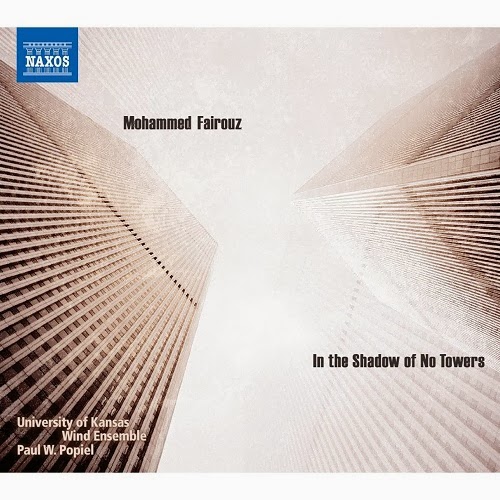
University of Kansas Wind Ensemble excels with Glass/Fairouz release

Philip Glass: Concerto Fantasy for Two Timpanists and Orchestra
Mohammed Fairouz: Symphony No. 4, 'In the Shadow of No Towers'
University of Kansas Wind Ensemble
Paul W. Popiel, conductor
Naxos


The University of Kansas Wind Ensemble turns in an excellent recording of some challenging and memorable compositions. this university ensemble is first-rate, especially the soloists. The ensemble blend is seamless, and the playing rock-solid.

Philip Glass' concerto, Fantasy for Two Timpanists and Orchestra, works quite well in this transcription for wind ensemble. Glass' sparse ensemble writing sounds even more so without strings. The result is a work with a razor-sharp edge to it.

Mohammed Fairouz's Symphony No. 4 was based on the Art Spiegelman graphic novel "In the Shadow of the Towers." Fortunately, one doesn't have to be familiar with the source to make sense of the music. Fairoz's composition uses the more traditional voicings found in wind ensemble literature. But that doesn't make this work any less original. His take on Spiegelman's take on 9/11 juxtaposes the known and familiar with the strange and unknown.

Although the work deals with an emotionally heavy topic, it does so in an authentic fashion. No maudlin tune to mourn the fall of the towers, nor uplifting Coplandesque hymn at the end to signify hope. Fairouz uses a sophisticated musical language to convey the complex and sometimes conflicting emotions 9/11 sparked. And I think he succeeds.

Friday, January 3, 2014

Penderecki: Piano Concerto "Resurrection"

Krysztof Penderecki: Piano Concerto "Resurrection"
Florian Uhlig, piano
Polish Radio Symphony Orchestra
Lukasz Borowicz, conductor
Hänssler Classic


The events of 9/11 triggered the creation of many musical works. Some are only of passing interest, while others, such as Pendereicki's piano concerto have taken on a life of their own. This new recording presents the revised version of this concerto. In 2007 Penderecki rewrote the final movement, and in the process made it a more hopeful and inspiring work.

Although some of the tone clusters and and atonal gestures reminded me of his 1964 "Threnody for the Victims of Hiroshima," Pendericki's piano concerto is a vastly different work. I'd almost classify it as post-romantic. It has the same sprawling bigness of a Rachmaninoff concerto. Although there's not a discernible cadenza, the piano plays almost non-stop throughout the work with virtuoso runs and chords. And although there are sections of great intimacy and delicacy, there are even more where the full orchestra's playing with maximum volume.

Florian Uhlig plays with the right emotional tone. He's a brilliant technician, of course, but he also understands that this is a work of deep emotion. Uhlig effectively communicates that emotion with virtually every note. And conductor Likasz Borowicz is right there with him. The work has some sudden shifts and juxtapositions, but under Borowicz' direction, there's never a misstep.

The revised "Resurrection" concerto is a powerful work that should find a place in the standard repertoire. Yes, it's that good -- and so is this recording.

Tuesday, December 31, 2013

Danielpour: Darkness in the Ancient Valley

Richard Danielpour: Darkness in the Ancient Valley
Nashville Symphony; Giancarlo Guerrero, conductor
Angela Brown, soprano
Hila Plitmann, soprano
Naxos


Darkness in the Ancient Valley is Richard Danielpour's attempt to return to his Persian heritage. The basis for this five-movement symphony is a 16th century Iranian poem.

To my ears, the opening movement sounds like film music trying to evoke a Middle Eastern setting. But as the work progresses, pastiche gives way to passion, and the music develops its own blended and original voice. The final movement for orchestra and soprano (Hila Plitmann, for whom the part was written) brings the work home with an emotional and transcendent finale.

Rounding out the release are two other orchestral works. Lacrimae Beati sounds a little like Copland with its open intervals. Although based on the first eight bars of Mozart's Requiem (reportedly the last music he ever wrote), Danielpour so completely integrates the source material that there's almost no trace of the original composer. And that's a good thing -- this is a deeply personal work, a musing on mortality. It would be jarring to Mozart's music stick out from the rest of the composition.

A Woman's Life, a setting of eight poems by Maya Angelou, has a distinctively American feel to it. But it's not Copland Americana. While the harmonies may sound similar, the rhythm of the words and the melodic seem to recall African-American gospel traditions. The work was composed for soprano Angela Brown, and her performance here infuses the words with understated drama and urgency. A beautiful orchestral song cycle that deserves a place in the repertoire.

Tuesday, December 24, 2013

John McDonald: Airy - Music for violin and piano

John McDonald: Airy, Music for Violin and Piano
Joanna Kurkowicz, violin
John McDonald, piano
Bridge


Airy brings together  John McDonald's music for violin and piano, bringing together light-hearted miniatures with more serious long-form compositions. It's an appealing program that's full of variety. Mad Dance, Op. 66 and the Suite of Six Curt Pieces, Op. 326 are just plain fun, while the major work, the Sonata for Solo Violin, Op. 219 is more complex composition with greater emotional depth.

In the program notes, McDonald says he considers many of these works to be songs without words -- and it's an apt description. Poem, Op. 12, for example, is based on the poetry of Samuel Beckett. The shape of the music is determined by the poem, although not a word is sung. That's also the case with Lily Events, Op. 97 (inspired by poetry collection),  and the Lines After Keats, Op. 336.

There's an audible chemistry between violinist Joanna Kurkowicz and the composer (who accompanies her). Airy is the title of the release, and airy it is.

Monday, December 23, 2013

Marcel Tyberg: Symphony No. 3 - A Voice Not Silenced

Marcel Tyberg
Symphony No. 3
Piano Trio in F major
Buffalo Philharmonic Orchestra; JoAnn Falletta, conductor
Michael Ludwig, violin; Roman Mckinulov, cello; Ya-Fe Chuang, piano
Naxos


Marcel Tyberg finished his third symphony in 1943, shortly before his arrest by the Nazis and death at Auswitz. Fortunately, he entrusted all of his scores to a friend and so they survived the war.

The symphony is a marvelous post-romantic work, and reminds me very much of Bruckner’s 4th Symphony without in any way sounding derivative. Tyberg’s melodies are full-bodied and bursting with energy. The Scherzo is a particular delight, and the adagio is absolutely gorgeous.

It’s a bittersweet listening experience. The symphony stands on its own merits, but it makes one wonder what Tyberg might have accomplished had he lived.

Coupled with the Symphony is the piano trio from 1936. Like the symphony, it’s a lush, romantic work with plenty of opportunities for all the players to shine. In a video promoting this release, JoAnn Falletta stated she’s fallen in love with Tyberg’s music. And her performance shows it.

Highly recommended.

Friday, December 20, 2013

Tyberg: Symphony No. 2, Piano Sonata No. 2

Tyberg: Symphony No. 2; Piano Sonata No. 2
Buffalo Philharmonic Orchestra; JoAnn Falletta, conductor
Fabio Bidini, piano
Naxos


Austrian composer Marcel Tyberg's career (and life) was cut short by the Second World War. Despite being a devout Roman Catholic, he was arrested by the Nazis in 1943 because his great grandfather was Jewish. Fortunately, he entrusted his music to a friend before his death in 1944 en route to Auschwitz.

Tyberg didn't compose many works, but the quality of them makes one wonder how he would have fared in a less toxic atmosphere. His second symphony, finished in 1931 is a big, post-romantic composition and reminded me of Erich Korngold's symphonic works. Tyberg seems more influenced by Beethoven than Brahms, however, with simple motives building and transforming themselves in rigorously logical fashion. The overarching themes were expressive examples of post-romanticism -- not as memorable as Rachmaninov's but still quite moving.

JoAnne Falletta and the Buffalo Philharmonic are thoroughly invested in this work, and that dedication shows. Falletta lets the music stand on its own strengths. The performance presents a well-constructed symphony that should be immediately appealing to  most listeners.

Coupled with the symphony is Tyberg's second piano sonata from 1934. Tyberg was a pianist and organist, and his composition takes full advantage of the instrument. The work ranges over the keyboard, with plenty of Liszt-inspired gestures. If Nicolai Medtner wrote more tightly organized music, he might have composed something along these lines.

Pianist Fabio Bidini performs the sonata with relish, delivering the music with all its inherent drama and brio.

Tuesday, October 8, 2013

Gergiev and LSO shine with Szymanowski symphonies

Szymanowski: Symphonies Nos.1 & 2
London Symphony Orchestra
Valery Gergiev, conductor
SACD Recording
LSO

Symphony No. 1 was composed when Szymanowski was only 24, and he seemed to have considered it a youthful indiscretion. Yes, parts sound derivative of Richard Strauss' tone poems, and the structure isn't very tight in places.

But the symphony's a work with a lush, romantic sound and that's the work's strength. Gergiev understands that and presents the work with unbridled enthusiasm. These may be the exaggerated passions of youth, but they're genuine -- and in this recording, they're taken seriously.

In some ways, Szymanowski's second symphony No. 2 is proto-concerto, with solo violin playing off the orchestra. The influences of Richard Strauss and Max Reger are evident; the former in the first movement, the latter in the intricate second movement's fugue. Gergiev shapes the music to make these relationships more apparent.

Szymanowski at 27 was a much more confident composer than he was three years earlier, and Gregiev artfully articulates the structure of the music -- especially in the theme, variations, and fugue of the second movement.

I strongly recommend the SACD version if you have an SACD player. Although a live recording, the performances by the London Symphony Orchestra are immaculate. Subtle details of the sound of the instruments and the acoustics of the hall really make the music come alive. An excellent addition to LSO's self-released catalog.